In this guide
A new practitioner’s first week decides a lot. Not their technique, which you hired them for. Whether your regulars stay when they see someone new. A client who books, sees an unfamiliar face, and gets asked “so, what brings you in?” for the fourth time in a year starts wondering why they’re still coming.
The handover is the owner’s job, and it’s mostly three things: choose the first clients well, make sure the new person reads before they touch anyone, and introduce them so the client feels handed over, not dropped.
Choose the first clients
Don’t give a new hire your most complicated client on day one. Start with regulars whose history is clear and whose notes are good.
- Clear cautions. Avoid lines written as movements, dates on every injury and surgery.
- Good recent notes. A Next time line the new person can actually follow.
- Easygoing about change. Some clients are happy to try someone new. Start there.
Save the recent surgery, the client who’s particular about pressure, and the one who’s been with the same practitioner for three years for week two or three, once the new person has the routine down.
What the new hire reads first
Before each session, the new practitioner reads the same things, in the same order, every time. Training new practitioners to read a client brief has the routine and a way to practice it on sample clients. In short:
- Cautions and the avoid list. The one thing they can’t get wrong.
- Last time’s Next time. What to start with today.
- The last two or three notes. Where the client’s been tight, what’s changed.
- Why they come. The goal, in the client’s words.
- One personal thread. Something to ask about.
Then ask them, before the client arrives: “What’s the one thing you won’t do today? What will you start with? What will you ask about?” If they can answer in under a minute, they’re ready.
The owner’s short intro
Clients worry about three things when their practitioner changes: whether the service will suffer, whether the new person will be as good, and how the changeover will be handled. Bendapudi and Leone found exactly that in their study of customers whose key contact left [1]. An intro from the owner answers all three before the client walks in.
Keep it short and specific. A text or an email a day or two before:
Hi Dana, Sam will be seeing you Thursday. He’s read your notes, so he knows about the left knee and where you and Priya left off with the hips. He’ll check in about pressure at the start. Let me know if you have any questions.
That’s it. It names the new person, shows the history came with the client, and says the most important thing they’ll want to know.
If you can, introduce them in person too, even for a minute at the front desk. Research on service relationships finds that rapport with the person serving you, an enjoyable interaction and a personal connection, is linked to loyalty and word of mouth [2]. A warm first minute is where that starts.
What the new practitioner asks the client
Even with a perfect brief, the first session with a new client is a little different. The new person should ask a few things and listen.
- “I’ve read your notes. Is there anything that’s changed since your last session?”
- “Is there anything Priya did that you’d like me to keep doing?”
- “Anything you’d rather I didn’t do?”
- “How do you like the pressure?” Then check in the first time they go deeper.
Then the first note, written right after, like any other. A good first note from a new practitioner also records what the client said about the change, if anything. “Said she was nervous about a new person, was happy by the end.” That’s useful for the owner too.
Check in after the first week
Pick two or three clients the new person saw and look at their notes. Are the Next time lines there? Is the side written down? Did they follow last time’s plan? Then ask the new practitioner what was hard. Thirty seconds of feedback in week one saves a lot later.
And if a client doesn’t rebook after the change, ask why. Bendapudi and Leone suggest spreading client contact across more than one employee, so no relationship rests on one person [3]. A studio where clients already know two practitioners hardly notices a new one. Keeping client history when a practitioner leaves covers the other side of the same problem.
Where Dorsova fits
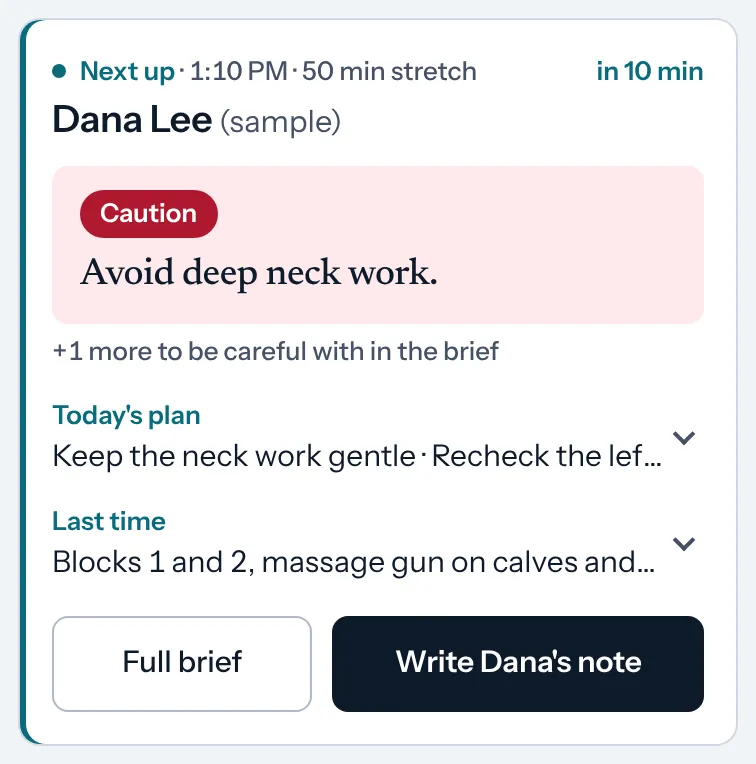
In Dorsova, the new practitioner sees the same 30-second brief everyone else does: cautions and the avoid list first, then the plan from last time’s Next time, what to ask about and why the client comes. Every note says who wrote it, so they know whose judgement they’re reading. The client’s whole history stays with the studio, whoever they book with.

Sources
- Managing Business-to-Business Customer Relationships Following Key Contact Employee Turnover in a Vendor Firm, Bendapudi and Leone, Journal of Marketing (2002)83.pdf)
- Customer-Employee Rapport in Service Relationships, Gremler and Gwinner, Journal of Service Research (2000)
- How to Lose Your Star Performer Without Losing Customers, Too, Bendapudi and Leone, Harvard Business Review (2001)