In this guide
A practitioner gives notice. Over the next two weeks you find out how much of your studio lived in their head. Which client has the shoulder, who likes it lighter on the left, who’s training for a marathon in March. Some of their clients follow them out. Some just drift off. This is about keeping that history in the studio, so the client stays even when the person they saw doesn’t.
Why history walks out the door
Clients get attached to people. The business comes second, and research on service relationships has shown this for decades.
- Loyalty to the person pays, and it moves. A study of 362 buyer and salesperson pairs found that loyalty owned by the individual salesperson was what drove sales growth, and it’s exactly the loyalty a firm risks losing when that person goes [1]. The authors’ advice was to build loyalty to the company’s own value as well, so customers stay loyal to both [1].
- Customers worry about three things when their person leaves. Bendapudi and Leone studied business customers after their key contact left. Customers worried whether service would suffer, whether the replacement would be as good, and how the changeover would be handled [2][3]. Many of the firms’ usual retention tactics didn’t work, because they were planned from the company’s side and not the customer’s [3].
- Clients follow what the person knows. A study of business buyers of advertising services found that a departing contact’s skills and knowledge were what pulled clients to follow them [4].
In a studio, what the business can actually own is mostly one thing: what the next practitioner knows about the client on day one. If the history left with the practitioner, that client’s next session starts from zero. They have to explain the knee all over again. And that’s the moment they start wondering why they’re still coming.
Why it matters to the business
Reichheld and Sasser’s classic work on service businesses argued that companies should aim to keep every customer they can profitably serve, and that customer defection rates are a leading indicator of profit swings [5]. Their other point matters just as much for a studio. Each defection tells you why clients leave, if you bother to look. When a practitioner’s regulars stop booking after they go, ask whether anyone handed their history over.
What a good handoff note has
Ask the leaving practitioner to write one for every regular client during their last two weeks. Don’t leave it to their last day. Each note should have:
- Cautions first. Injuries and surgeries with dates, as the client reported them. What to avoid, written as movements: “No deep twisting of the low back.” “Back issue” doesn’t tell the next person anything.
- Why they come. The goal in the client’s words. “Wants to get back to golf without the back seizing up.”
- What works. Pressure, positions, what they like to start with. “Likes to start lying face down. Medium pressure, lighter on the left hip.”
- What doesn’t. “Doesn’t like the neck worked much. Hates being cold.”
- Where things stand. The last session or two, and where they’ve been tight. “Right hamstring has been the tight one for a month.”
- What to ask about. The personal thread. “Daughter’s wedding in November.”
- Who wrote it, and when.
Then do the thing most studios skip. If you can, introduce the new practitioner while the old one is still there. That answers all three of the client’s worries directly.
One record per client, across every location
If you run more than one studio, the trap is a client with three partial records, one at each location, each with a different practitioner’s notes. A handoff fixes one practitioner leaving. One record per client fixes it for good.
- One client, one history. Every location adds to the same record.
- Every note is signed with who wrote it and when, so the next person knows whose judgement they’re reading.
- Notes belong to the studio. They don’t live on a practitioner’s phone, in a notebook or in a personal account. Say so when you onboard people, kindly and early.
- Somebody reads it before every session. A record no one reads doesn’t keep anyone.
With several studios, the record is only half of it; the notes also need to read the same everywhere. Keeping session notes consistent across locations covers that, and what a stretch studio needs from a session-notes app has the questions to ask about who owns the records before you pick one.
Before anyone leaves
The best handoff is the one you never need. A few habits turn a resignation into a non-event:
- Notes get done every session, right after. The end of the week is too late.
- More than one practitioner knows each regular. Share clients a little, with a cover session now and then. Bendapudi and Leone suggest the same thing, spreading customer contact across more than one employee [3].
- Check note quality once a month. A thin note (“good session”) is a handoff that’s already failed.
The other half of a handoff is the person coming in. Handing a new practitioner their first clients covers which clients to give them first and what they read before each session; whether the notes you kept were on paper or in a shared doc, paper vs an app for session notes compares the two.
Where Dorsova fits
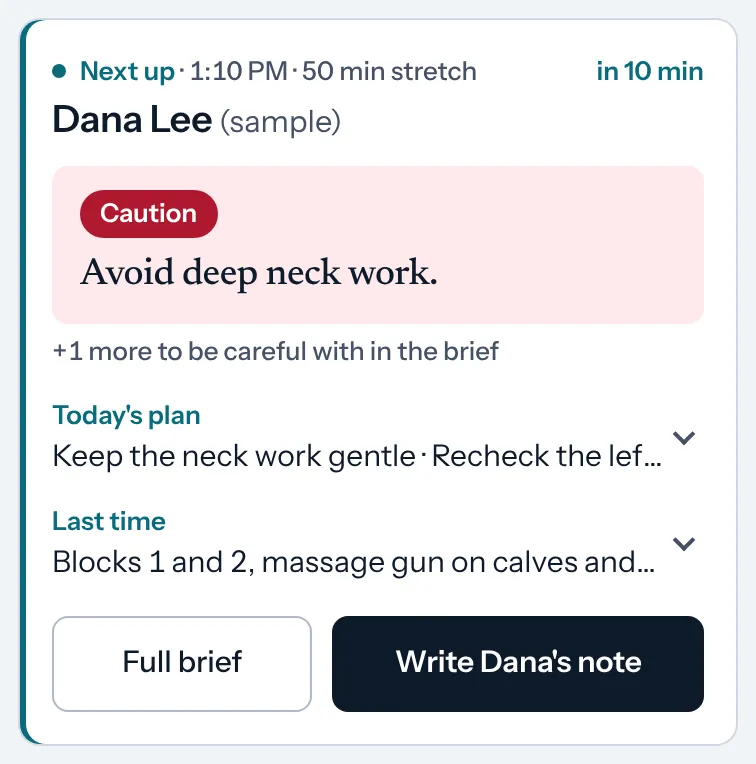
In Dorsova, notes belong to the studio and each one says who wrote it, so a client’s full history stays in one record when a practitioner leaves. Whoever the client books with next reads a 30-second brief first, with their injuries and what to avoid at the top. It works beside your booking software.

Sources
- Customer Loyalty to Whom? Managing the Benefits and Risks of Salesperson-Owned Loyalty, Palmatier, Scheer and Steenkamp, Journal of Marketing Research (2007)
- Managing Business-to-Business Customer Relationships Following Key Contact Employee Turnover in a Vendor Firm, Bendapudi and Leone, Journal of Marketing (2002)83.pdf)
- How to Lose Your Star Performer Without Losing Customers, Too, Bendapudi and Leone, Harvard Business Review (2001)
- If the Supplier’s Human Capital Walks Away, Where Would the Customer Go?, Biong and Ulvnes, Journal of Business-to-Business Marketing (2011)
- Zero Defections: Quality Comes to Services, Reichheld and Sasser, Harvard Business Review (1990), via Bain & Company