In this guide
An avoid list is the most important thing in a client’s record, and it’s usually the worst-written. “Bad knee.” “Careful with back.” “Shoulder??” I’ve written a couple of those myself early on.
None of them tell the next practitioner what to do. They don’t even tell you, three weeks later, when you’ve forgotten the conversation. This page is about the wording. The questions that get you the lines in the first place are in working with a client after surgery and, for trainers, keeping track of client injuries.
Write the movement, not the diagnosis
An avoid line answers one question: what shouldn’t you do with this body? So write a movement and a place.
- “Twisting or torque at the left knee.”
- “No hip flexion past 90° on the right.”
- “Avoid aggressive neck work.”
- “No weight through the left arm.”
Compare that with “torn meniscus” or “bad knee.” The diagnosis belongs in the injury history, in the client’s words, with a date. The avoid line is the practical part, the thing you change about the session because of it.
There’s a scope reason too. Hands-on practitioners and trainers don’t diagnose. ACE’s manual puts diagnosing and treating outside a trainer’s scope [1], and NASM’s handbook says the same, adding that trainers refer clients with pain or disease to health care professionals [2]. An avoid list written as movements keeps you on the right side of that line. It’s your precaution about how you’ll move them. It’s not a claim about what’s wrong with them.
What the client says it is, the side and the date belong in the history, not the avoid list; how to keep each entry is in recording a client’s injury history.
Where the lines come from
Every line should trace back to something somebody said. Usually it’s one of these:
- The surgeon or PT. “My PT said no deep squats until the end of the month.” That’s the most important source, and it goes in close to word for word.
- The client. “I don’t want anyone near my neck.” Their call, no reason needed.
- You. You noticed the right shoulder doesn’t like being taken across the body, so you’re keeping it out until you know more. That’s your recommendation, and it’s fine to write it as one.
What doesn’t belong on the list is advice you’d be making up. ABMP’s ethics column on giving advice puts the test simply, whether it’s outside your scope and what it does to the relationship [3]. Telling a client to drop or swap something their doctor prescribed fails that test. If the client says their doctor has them doing something, you work around it. You don’t overrule it.
Make it specific
Specific means side, area and movement. “Careful with the knee” fails all three. “Twisting or torque at the left knee” passes.
It also means limits when you have them. “No hip flexion past 90°” is better than “careful bending the hip,” because the next person knows exactly where to stop. If the PT gave a number, use it.
Think in movements they don’t tolerate
Most of my avoid lines start here now, and it’s the most useful habit on this page. Instead of “ankle issue” or “back thing,” write down which movement the client doesn’t tolerate. Extension intolerance. Pivoting intolerance. Single-leg loading intolerance. Then turn that into a line the next person can follow.
The common ones, and how to write them:
- Extension intolerance. Arching the low back bothers them. “Arching the low back, prone press-ups past comfort.”
- Flexion intolerance. Bending forward bothers them. “Loaded or repeated forward bending of the spine.”
- Rotation intolerance. “Twisting through the spine with the hips fixed.”
- Pivoting intolerance. “Twisting or torque at the knee with the foot planted.”
- Single-leg loading intolerance. “Full weight on the left leg alone (single-leg work).”
- Deep hip flexion intolerance. “Bending the hip past about 90°, knee to chest.”
- Ankle inversion intolerance. “Rolling the ankle in (inversion) under load or at end range.”
Put the side on it when there is one, and say where it came from. “She says arching her back flares it” is the source, and it goes right next to the line.
None of that is a diagnosis. You’re writing down what the client tolerates, which is exactly what you need to know to move them. And it travels. A pivoting intolerance matters whether it came from an old ACL, a meniscus or nobody knows what, and it matters on the table, on the turf and in the weight room. The next practitioner doesn’t need the cause to know what to keep out.
Make it match the stage
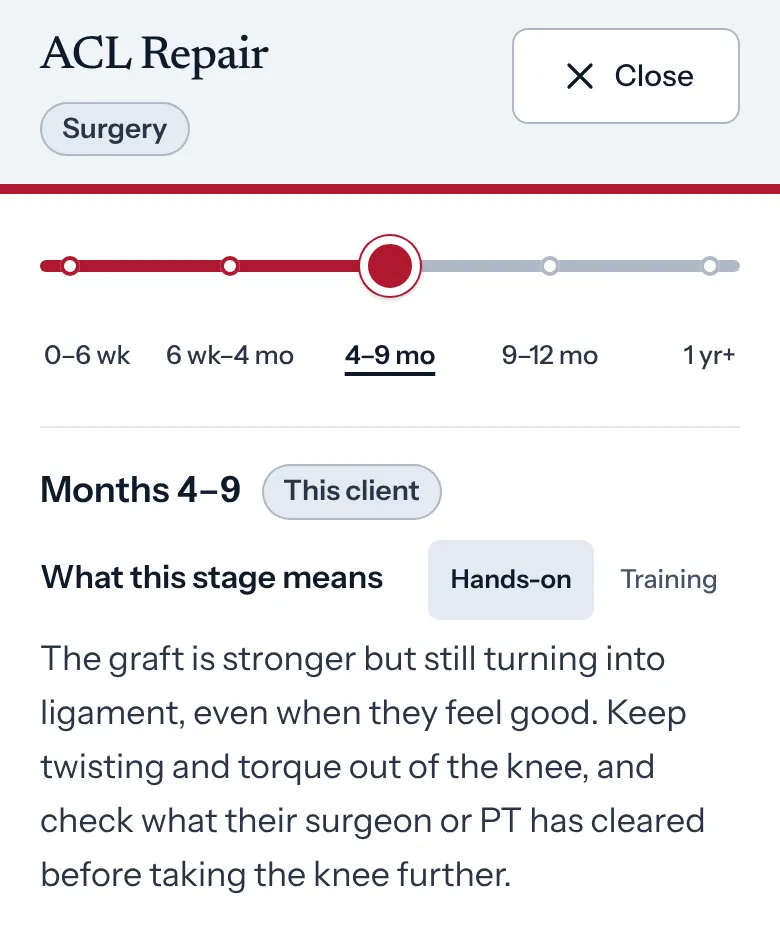
Avoid lists go stale. A line that was right at six weeks after an ACL repair may be too cautious at six months, and a line written for a fresh strain might not matter at all once it’s healed.
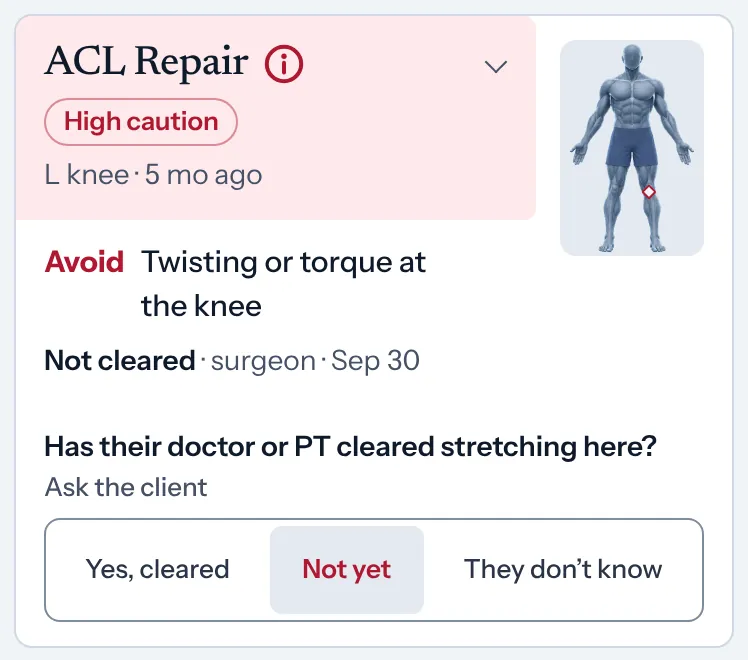
So put a date or a stage on the lines that come from a clinician. “No resisted hamstring work until cleared by PT (said 8 weeks, from 9/1).” Then when the client tells you the PT cleared them, you update the line that day and note who said so and when. Never take a line off because you think it’s probably fine by now. It comes off when the client tells you it’s been lifted.
The 50-year-old golfer with a calf strain is a good example. Early on the line is “no stretching into the left calf, client reports it’s still sore to walk on.” A few weeks later, if he tells you it’s easing, it might become “light work only on the left calf, check in.” The list follows what he tells you.
Use it every session, then check the note against it
Physical therapists think along the same lines, and it helps to know what their world looks like. There are several published ways of grouping low back pain by the direction of movement that brings it on, and a 2012 review compared five of them [6]. The McKenzie approach, for one, looks for a directional preference, a direction of movement that eases the symptoms [7]. Classifying is their job, not ours. We’re writing down what the client told us bothers them, so we don’t do it.
The list only works if you read it before you start, and if the note afterwards shows you stayed inside it.
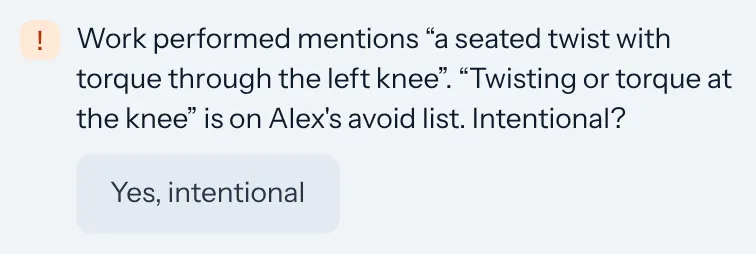
That’s where a note check helps. A rule-based check reads what you wrote under the work you did and compares it with the client’s avoid list. If you wrote “rotational work on the left knee” and the list says “twisting or torque at the left knee,” it asks if that was on purpose. Maybe it was. Maybe the PT cleared it last week and you haven’t updated the list. Either way you catch it before the note’s saved.
It works because both sides are written the same way. A movement and a place on the avoid list, a movement and a place in the note. “Bad knee” gives a rule nothing to match, and it gives a person nothing to act on either.
Your notes are a record of the work. AMTA describes SOAP notes as how you track a client’s condition and progress from intake on [4], and ABMP calls them a legal record of the work [5]. If the avoid list says one thing and the note says you did the opposite with no explanation, that’s a problem on paper even if the client was fine.
Where Dorsova fits
When you add an injury or surgery in Dorsova and say when it was, it suggests avoid lines and a caution level for that stage, and your recommendation decides. Every brief shows them first. After the session, Dorsova checks the note against the client’s avoid list, by rules and never by AI. If something on it shows up, it asks “Intentional?” before you save.
Sources
- Role and Scope of Practice for the Personal Trainer, ACE Personal Trainer Manual, 5th ed., Chapter 1, American Council on Exercise
- NASM Candidate Handbook, National Academy of Sports Medicine
- Advice May Be Contraindicated, Massage & Bodywork, ABMP (2024)
- Massage Therapy SOAP Notes, American Massage Therapy Association
- Superior Outcomes, Massage & Bodywork, ABMP (2025)
- Physiotherapy movement based classification approaches to low back pain: comparison of subgroups through review and developer/expert survey, Karayannis, Jull and Hodges, BMC Musculoskeletal Disorders (2012)
- Centralization and directional preference: a systematic review, May and Aina, Manual Therapy (2012)