In this guide
Halfway through the intake, a client mentions they had their hip replaced in the spring. The next two minutes matter more than whatever you’d planned for the session. This checklist is for hands-on practitioners who aren’t the client’s clinician: massage therapists, trainers, assisted stretching and recovery practitioners.
One rule sits above everything else here. The surgeon’s or PT’s instructions are the rules. The rest of this is about asking for them, writing them down and working inside them.
The checklist
- Which operation, which side, and when? Month and year at least. “Left hip replacement, May 2026” is the line you want.
- How was it done? The details change the rules: the approach for a hip replacement, the graft for an ACL, which tendons for a rotator cuff, which levels for a fusion. If they don’t know, ask them to find out.
- What has the surgeon or PT told them to avoid, and for how long? Get it in their words. Ask if they have the sheet.
- What have they been cleared to do? Cleared to walk doesn’t mean cleared to bend the hip deeply.
- Are they still in rehab? If they are, their PT’s plan comes first, and your work fits around it.
- Has anything changed? New pain, swelling, or a follow-up visit that changed the limits.
- Write it all down before you touch them. Then reread it every session until the restrictions lift.
What to expect from their surgeon or PT
This is the usual shape of the team’s plan, from published protocols. They vary by surgeon, and your client’s own list is the one that counts. Use it to know what to ask about, never as limits of your own.
Hip replacement
The precautions depend on where the surgeon went in. After the posterior (back) approach, the usual list keeps deep hip bending, crossing the leg past the midline and turning the leg inward out of the session, typically for 6 to 12 weeks (some surgeons say 3 months, some now give none) [1][2][8]. After the anterior (front) approach, the list is usually about taking the leg far behind the body and turning it far outward, and some anterior surgeons set no formal precautions. One university guideline also says to go easy on loading the gluteus medius after the front and side approaches [2].
Surgeons differ on these partly because the research on whether precautions prevent dislocation is mixed [3], which is why some now give none. That’s not a reason to drop a precaution a client has been given. Their surgeon’s list is the one you follow, and that’s why you ask.
ACL repair
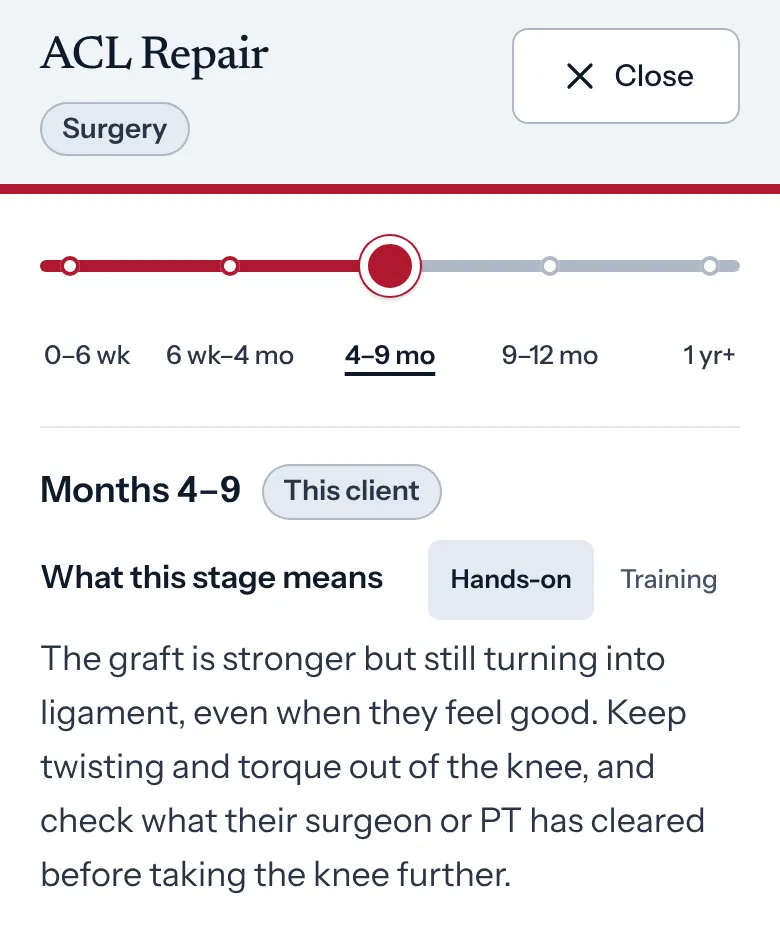
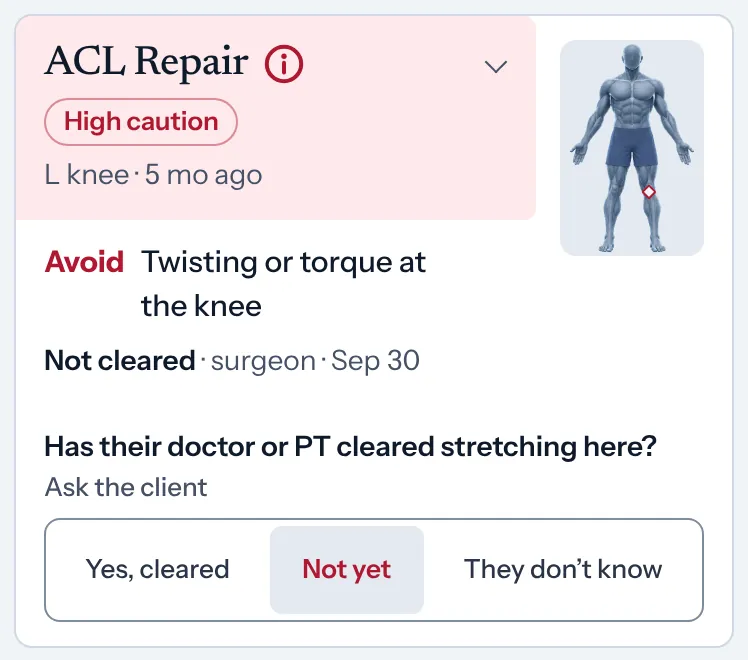
Protocols vary by surgeon and by graft. When the graft came from the hamstring tendons, many protocols keep stretched or resisted hamstring work out for 4 to 12 weeks [4][10][11]. That one matters a lot in a stretch session. A graft from the patellar tendon leaves a sore donor site at the front of the knee for months, so kneeling can be uncomfortable. Twisting with the foot planted stays out for months. The return to pivoting sport is the PT’s or surgeon’s call, usually not before 9 months and only after their testing, and many people aren’t there yet at 9 months [5]. A client at that mark is often still mid-rehab, and your work fits around that.
Rotator cuff repair
What to expect from the surgeon’s and PT’s plan: a sling for 4 to 6 weeks (6 for large tears), and passive motion only at first, within the surgeon’s limits. The PT usually starts active motion from about 6 weeks and strengthening from 10 to 12 weeks. Weight through the arm (push-ups, planks) is commonly kept out to around 12 weeks or more [9]. After a large tear, the surgeon may also limit how far the arm turns out and lifts to the side early on [6]. The dates on the client’s own sheet decide; these are the usual shape of it.
Spinal fusion
What to expect from the surgeon’s instructions: for the first 6 weeks (12 with some surgeons) the spine stays out of bending, lifting and twisting, usually with a lifting cap, often 10 to 25 lb. One surgical group’s instructions keep bending and twisting out for at least 3 months [7]. The bone can take 6 to 12 months to fuse fully. Ask the surgeon or PT what the fusion means for this client longer term, including rotation and bending near that level, and write their answer down. Ask which levels and how many, too. One level and a long fusion are very different clients.
Defer, every time
- If the client’s sheet and this guide disagree, go with the sheet.
- If they don’t know their limits, keep to gentle work away from the surgical area and ask them to check with the surgeon or PT before the next session.
- If something feels off (new swelling, pain they haven’t mentioned before, numbness), stop that part of the session and suggest they contact their clinician. Then note that you did. (How to say it without scaring them.)
Write down what you were told
Until the restrictions lift, every note after a surgery should carry three things:
- What they told you, with the date: “Client reports surgeon’s limits: no hip flexion past 90°, no crossing legs, until 8/15.”
- What you did and what you kept out: “Lower body. Kept left hip below 90°, no adduction across midline.”
- What changed: “Client reports PT lifted the hip precautions on 8/20.” Then update the avoid list that same day. (How to word those lines and keep them matched to the stage: writing avoid lists.)
The surgery itself goes on the client’s history for good, with the date and who’s treating it: recording a client’s injury history. Many clients after surgery are older, and the table, the turn and dizziness on standing are in working with older clients.
Where Dorsova fits
Dorsova’s injury library has 104 researched injuries and surgeries, including the four above. Pick one and say when it was, and it suggests what to avoid and a caution level for that stage; your recommendation decides. From then on every brief shows those cautions first, in front of whoever the client books with.
Sources
- Total Hip Replacement, OrthoInfo, American Academy of Orthopaedic Surgeons
- Total Hip Arthroplasty Clinical Practice Guideline, Ohio State University Sports Medicine (2022)
- Do hip precautions after posterior-approach total hip arthroplasty affect dislocation rates? A systematic review, Acta Orthopaedica (2020)
- ACL Reconstruction, Hamstring Tendon Autograft Protocol, Brigham and Women’s Hospital
- Low rates of patients meeting return to sport criteria 9 months after ACL reconstruction, Welling et al., Knee Surgery, Sports Traumatology, Arthroscopy (2018)
- Rehabilitation Protocol for Rotator Cuff Repair, Large to Massive Tear, Mass General Brigham
- Lumbar Fusion Patient Instructions, OrthoBethesda (2020)
- Total Hip Arthroplasty Protocol, All Approaches, Orthopedic Institute, Sioux Falls
- Rehabilitation Protocol for Rotator Cuff Repair, Small to Medium Tear, Mass General Brigham
- ACL Reconstruction with Hamstring Autograft, AOA Orthopedic Specialists
- ACL Reconstruction Rehabilitation, University of Virginia Orthopaedic Surgery (2023)