In this guide
Every trainer has a client with a bad knee. The trouble starts when that knee lives only in your head, or on a form from eight months ago, and today’s program has walking lunges in it. Three habits keep it in front of you: screen properly, check every program against the list, and know when to ask for clearance. (For the note after each session, see personal trainer session notes.)
Screen before the first session
Two tools do most of the work, and both are free.
The PAR-Q+ is a questionnaire the client fills in themselves. They answer seven yes-or-no questions. A yes leads to follow-up questions and, where needed, the more detailed online ePARmed-X+ [1]. It was built to lower barriers to activity while catching the people who need more screening first [1].
Then there’s ACSM’s preparticipation screening. Since 2015, the American College of Sports Medicine’s algorithm decides on medical clearance using three things: whether the person exercises now, whether they have signs or symptoms or known heart, metabolic or kidney disease, and how hard they want to train [2][3]. Counting risk factors no longer drives the clearance decision [3].
The PAR-Q+ asks one question about bone and joint problems, and ACSM’s algorithm asks none. So add four of your own:
- Past injuries and surgeries. What, which side, and when. Month and year is enough.
- What their doctor or physical therapist has told them. Any limits, in their words.
- What they’re still seeing someone for. If they’re in rehab now, their PT’s plan comes first.
- What hurts today. Where, and how much, as they report it.
Write it down the way the client tells it: “Client reports right ACL reconstruction, March 2025. PT cleared jogging; no cutting yet.” That’s a record. You haven’t diagnosed anything.
Turn each injury into movements
You can’t check a program against “bad knee.” You can check it against a movement. So each injury becomes one to three lines you could actually spot in a workout: “Twisting or pivoting on the planted right foot.” “Pressing overhead with the left arm.” Describe the movement and leave the exercise out of it: “Deep knee bending under load” covers squats, lunges and leg press, and “No squats” misses the other two. How to write those lines, where they come from and when they change is in writing avoid lists.
Check every program against the list
The list only works if you actually look at it.
- Before the session, read the avoid list before you read the plan. It takes ten seconds.
- When you write or change a program, go line by line. Does this exercise put load through anything on the list? Lunges, step-ups and box jumps all bend the knee under load. Burpees and push-ups both put weight through the wrists and shoulders.
- When you swap something on the fly, check that too. The swap you pick at speed is the one that slips through.
- After the session, note anything on the list you did on purpose, and why. “Light bodyweight split squat, right side, cleared by PT on 10/2.” If it wasn’t on purpose, write that down too, and tell the client.
When to refer, and when to get clearance
Your job is to train the person. Working out what’s wrong with them belongs to someone else. ACE’s guidance is direct: don’t try to diagnose or treat a suspected injury yourself [4]. The accepted practice is to refer a client with a suspected chronic injury to their physician, who can send them on to an orthopedic specialist, physical therapist or athletic trainer [4].
Ask for clearance, and write it down, when:
- The screen says so. ACSM’s algorithm says when clearance is recommended, and a yes on the PAR-Q+ leads to the follow-up questions that decide it [1][2].
- They’ve had surgery recently, or they’re still in rehab.
- Something’s new or worse: pain that’s changed, spread or won’t settle, or anything you can’t explain.
- You’re unsure. That’s reason enough on its own.
ACE recommends medical clearance so that what you program doesn’t aggravate an existing condition [4]. Keep a referral network of local physical therapists and doctors you trust, so the referral is easy to make [5]. How to bring it up without scaring the client is in when to refer out.
When clearance comes back, record who gave it, the date and the exact limits. “Cleared by Dr. Lee 10/14 for full squats, no jumping until 12 weeks post-op.” Then update the avoid list that same day.
Stay in scope
- Record what the client reports and what you see. “Says right knee aches after runs” and “right knee drifts inward on step-downs” are both yours to write. “Patellofemoral pain” isn’t, unless those are the client’s clinician’s words.
- The clinician’s limits sit above your own plan. When they disagree, theirs wins.
- Follow your state’s rules and your certification’s code wherever they’re stricter than this page.
What each injury entry should hold, in the client’s words, is in recording a client’s injury history; the note that goes beside the program is in the personal trainer notes template.
Where Dorsova fits
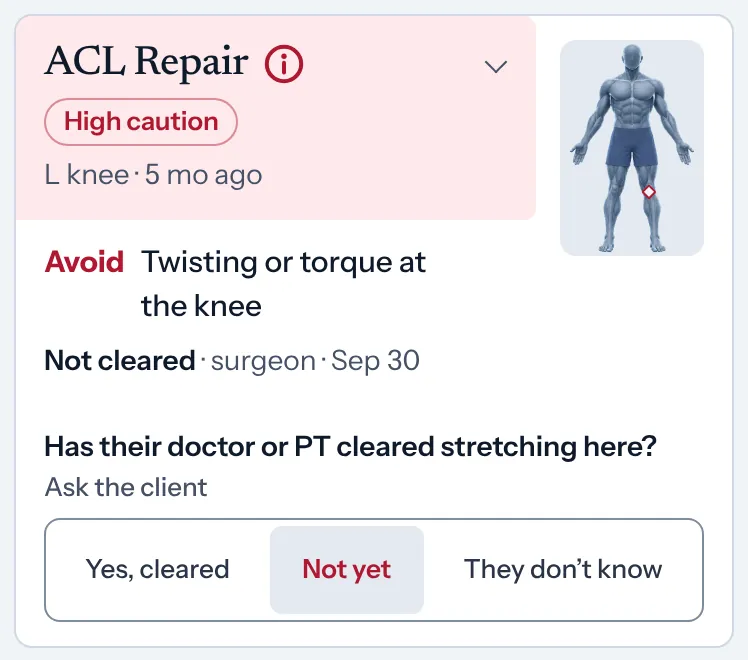
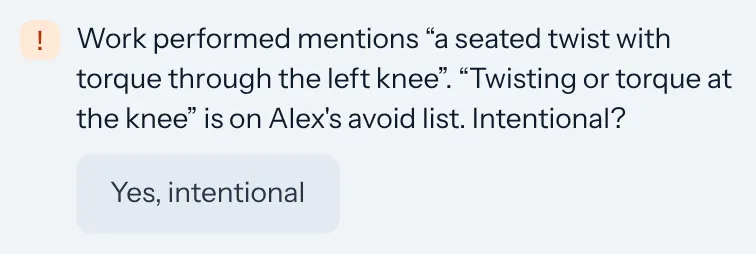
Dorsova puts each client’s injuries and avoid list first in a 30-second brief before the session. Afterwards you talk or type the note in about a minute, and if the work you describe matches something on the avoid list, it asks “Intentional?” before you save.
Sources
- PAR-Q+ and ePARmed-X+, HealthLink BC
- ACSM’s New Exercise Preparticipation Screening: Removing Barriers to Initiating Exercise, American College of Sports Medicine (2018)
- Updating ACSM’s Recommendations for Exercise Preparticipation Health Screening, Riebe et al., Medicine & Science in Sports & Exercise (2015)
- How to Train a Client with Chronic Injuries, Erin Nitschke, American Council on Exercise
- Medical Scope of Practice for the Personal Trainer, National Federation of Professional Trainers