In this guide
Most of what walks into a hands-on studio is ours to handle. Somebody tweaked their back shoveling, picked up a kid funny, took a step wrong in the backyard. That’s where we earn our keep, and it’s a lot of the value we bring.
Every so often, though, something’s off. It doesn’t behave like a tight muscle, or the client says something that makes you stop. Knowing when to say “I want you to see your doctor or PT about this first” is part of the job. It doesn’t mean you failed. Saying it well, and writing it down, matters as much as the call itself.
Stay in your lane
Neither of us diagnoses. NASM’s handbook puts it plainly for trainers: they don’t diagnose or treat pain or disease, and they refer clients with those needs to health care professionals [1]. ABMP’s code of ethics has its members acknowledge the limits of massage therapy and refer clients to other health care professionals when indicated [2].
So the question is never “what is this?” You don’t need to know. The question is “is this something I should be working on today, or does someone qualified need to look at it first?”
When the professional bodies say to pause
No made-up red-flag list here. This is what the professional bodies actually say.
When screening says so. The PAR-Q+ opens with seven general health questions. If a client answers yes to any of them, the form sends them on to follow-up questions or to talk to their health care provider before becoming more active [3]. If you use it, follow it.
Heart, metabolic or kidney disease, or signs of it. Under the ACSM screening guidelines, as ACE summarizes them, a client starting exercise who has cardiovascular, metabolic or renal disease, or signs or symptoms of one, should get medical clearance before regular exercise. A client who’s already active and develops signs or symptoms needs clearance before vigorous work [4]. ACE also notes that exercise-related cardiac events are rare and are often preceded by warning signs [4], which is why the signs a client mentions in passing (chest discomfort, unusual breathlessness, dizziness) are worth taking seriously.
Dizziness and fainting. NASM tells trainers to refer clients with unexplained dizziness, recurrent fainting, or symptomatic low blood pressure that hasn’t been looked at, and when symptoms are getting worse [5].
When it’s outside what you do. AMTA’s guidance on ethics says that knowing your scope means knowing your limits, and that includes knowing when to end treatment and refer out [6].
When the client’s own clinician has set limits you can’t work inside. If the surgeon or PT said no work on that area yet, then no work on that area. If the client doesn’t know what their limits are after a surgery, keep away from the area and ask them to find out before the next session.
A doctor’s note isn’t a substitute for thinking
ABMP has a good piece on this. A note from a physician who doesn’t know what you actually do isn’t a replacement for your own judgment, and the client’s provider is someone to talk to when you have a specific question, not someone to ask for permission [7].
It works on the table too. “Is it okay to get a massage?” gets a vague yes. “My practitioner wants to know if there’s any restriction on twisting at the lower back after your fusion” gets a useful answer.
How to say it
The goal is that the client leaves feeling looked after, not frightened. A few things that help:
- Make it about wanting to get it right. “I want to make sure I’m helping and not getting in the way. Can you check this with your doctor before we work on it?”
- Be specific about what you noticed, in plain words. “You mentioned the numbness has been getting worse.” Don’t guess at a cause. You don’t know, and saying “that sounds like a nerve thing” can scare someone for no reason.
- Say what you can still do today. Usually there’s plenty. If the left shoulder’s off limits, the hips and legs aren’t.
- Make it easy to come back. “Let me know what they say and we’ll pick it up from there.”
Avoid anything that sounds like a diagnosis, or a guess dressed up as one. “This could be serious” helps nobody. “I’d like your doctor to take a look before I work on that” is honest and calm.
Write it down
This part gets skipped, and it’s the part that protects everybody.
- What the client told you or what you noticed, in their words where you can. “Client reports numbness down left arm, worse this week.”
- What you suggested. “Suggested client check with their doctor before further work on the neck and left shoulder.”
- What you did and didn’t do today. “Lower body only. No neck work.”
- What changed later. “Client reports doctor cleared neck work, 11/4.” Then update the avoid list the same day.
The next practitioner who sees that client needs to know all of this before they start. Otherwise somebody new books them on a Saturday, doesn’t know, and goes straight for the neck.
Not every bad day afterwards needs a referral. What to ask first, and what to say, is in when a client says they felt worse after a session.
Where Dorsova fits
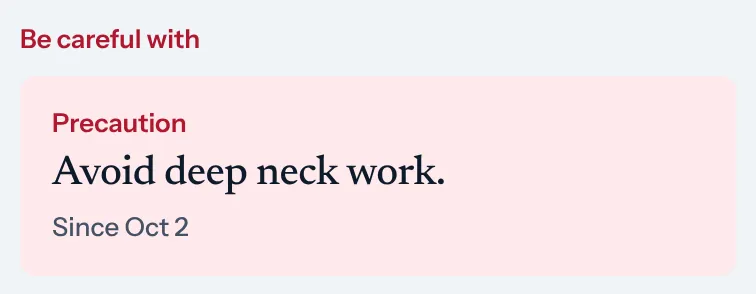
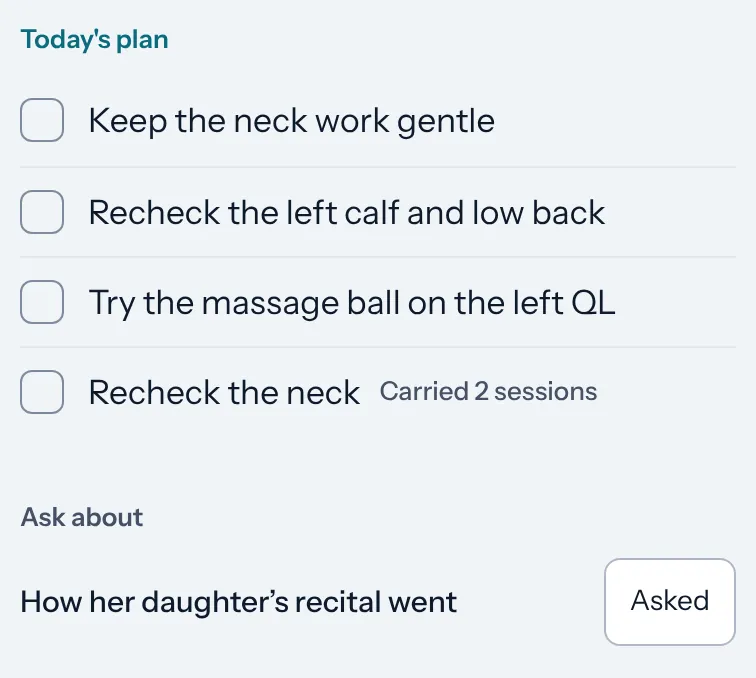
In Dorsova, the cautions and avoid lines you write are the first thing every brief shows, in front of whoever the client books with. Put “Ask whether the doctor cleared neck work” in the note’s Next time and keep it when Dorsova offers it: it comes back under Follow-ups before their next session, whoever sees them; tap Done when you have.
Sources
- NASM Candidate Handbook, National Academy of Sports Medicine
- ABMP’s Code of Ethics for Massage Therapists, Associated Bodywork & Massage Professionals
- The Physical Activity Readiness Questionnaire for Everyone (PAR-Q+), PAR-Q+ Collaboration (2024)
- New Preparticipation Screening Guidelines: What Health and Fitness Pros Need to Know, American Council on Exercise
- Low Blood Pressure and Exercise: What Personal Trainers Should Watch For, National Academy of Sports Medicine
- Massage and Ethics, Massage Therapy Journal, American Massage Therapy Association
- Stop Telling Massage Therapists to Get a Doctor’s Note, ABMP