In this guide
Sooner or later somebody tells you to write SOAP notes. Good advice, with a catch: SOAP comes from medicine, and copied straight from a clinic it has you writing things that aren’t yours to write. Here’s what goes under each letter when you’re a trainer, a stretch practitioner or a massage therapist and not anybody’s clinician.
What SOAP is
SOAP stands for Subjective, Objective, Assessment and Plan. It’s a way of organizing a note that health care providers have used for decades, and StatPearls describes each part: what the patient reports, what’s observed and measured, the provider’s assessment, and the plan [1]. The American Massage Therapy Association offers a SOAP notes form for keeping track of massage clients’ conditions and progress [2], and ABMP’s magazine has made the case for charting this way too [3].
The structure is good. It makes you separate what the client told you from what you saw, and it ends every note with what happens next. The trouble is one letter.
The A is where people overstep
In a clinic, Assessment is the clinician’s judgement: what’s wrong and why. That’s diagnosis, and diagnosis isn’t ours. ACE’s manual puts diagnosing outside a personal trainer’s scope [4], and massage practice laws keep it out of a massage therapist’s too. Ohio’s rule, for example, says plainly that a massage therapist shall not diagnose [5].
So when a non-clinician writes “A: piriformis syndrome” or “A: rotator cuff impingement”, they’ve written a diagnosis into the client’s record. Even if they’re right, it isn’t their call, and the next person reads it as fact.
Keep the four parts and change what goes in the third one.
What goes under each letter
- S, what the client tells you. How they are, in their words. Their goal for today. Pain or tightness only as they report it: “Says low back stiff after a long drive, 4/10.” Anything a doctor or PT told them, as theirs: “Says her PT called it a strain.”
- O, what you saw and what you did. The work in the order you did it, with the position. What you observed: which side was tighter, what moved more freely. “Face up: hamstrings, hips. Left hamstring noticeably tighter than right.” For a trainer, the exercises, the loads and what you saw: “Goblet squat 3x8 at 35 lb, knees drifted in on the last reps.”
- A, how they responded. The response goes here, not a judgement about what’s wrong. What they said during and after, and what changed in the session. “Said the back felt looser. Hips moved more by the end. Left hamstring still tight.”
- P, next time. One or two specific things for whoever sees them next. “Start with the left hamstring. Ask how the drive home was.” And anything you suggested: “Suggested they ask their doctor about the tingling in the left hand.”
Written that way it’s still SOAP, and every line is something you can stand behind.
An example
A made-up client, after a long drive:
S: Says low back stiff after a four-hour drive, 4/10. No new injuries. Wants to get back to golf this weekend. O: Face up: hips, then hamstrings, then a gentle knee-to-chest. Left hamstring tighter than right. Turned once. Face down: glutes, light work along the low back muscles, no pressure on the spine. A: Said the back felt looser by the end, 2/10 when he sat up. Left hamstring still tight. P: Start with the left hamstring. Ask how the round went. Keep the knee-to-chest light.
Nothing in that note says what’s wrong with his back. It says what he reported, what was done, what happened and what’s next. The next practitioner can use it, and anyone can read it. Five more, written for massage (a first visit, a client who brings a diagnosis, a client on a blood thinner, a referral), are in massage SOAP note examples.
Words to keep out of any note
This list holds for every note you write, SOAP or not. A quick check before you save:
- Diagnoses you didn’t receive. “Sciatica”, “tendinitis”, “impingement”, “herniated disc”. Only as the client reported them, and say so: “Client says their doctor called it tendinitis.”
- Treatment words. “Treated”, “corrected”, “released the adhesion”. Write what you did: “worked the right upper trap with sustained pressure.”
- Promises. “Will fix”, “should resolve”. Write what happened: “said it felt easier.”
- Advice about medicine. If a medication matters to the session, write it down as they named it. What they take is for their doctor.
You don’t have to call it SOAP
My own notes use plain names for the four parts: session note, work performed, response, next time. Same structure. The plain names keep people out of clinic language without anyone having to think about it (how to write session notes fast uses them). If your studio, your certifying body or your state board asks for SOAP by name, use the letters and keep the A honest. If their rules are stricter than this page, theirs win.
The plain version, the same four parts without the letters, is the session notes template. If you’re deciding between SOAP software and something simpler, a SOAP-note app or Dorsova compares them and says who should stay with SOAP.
Where Dorsova fits
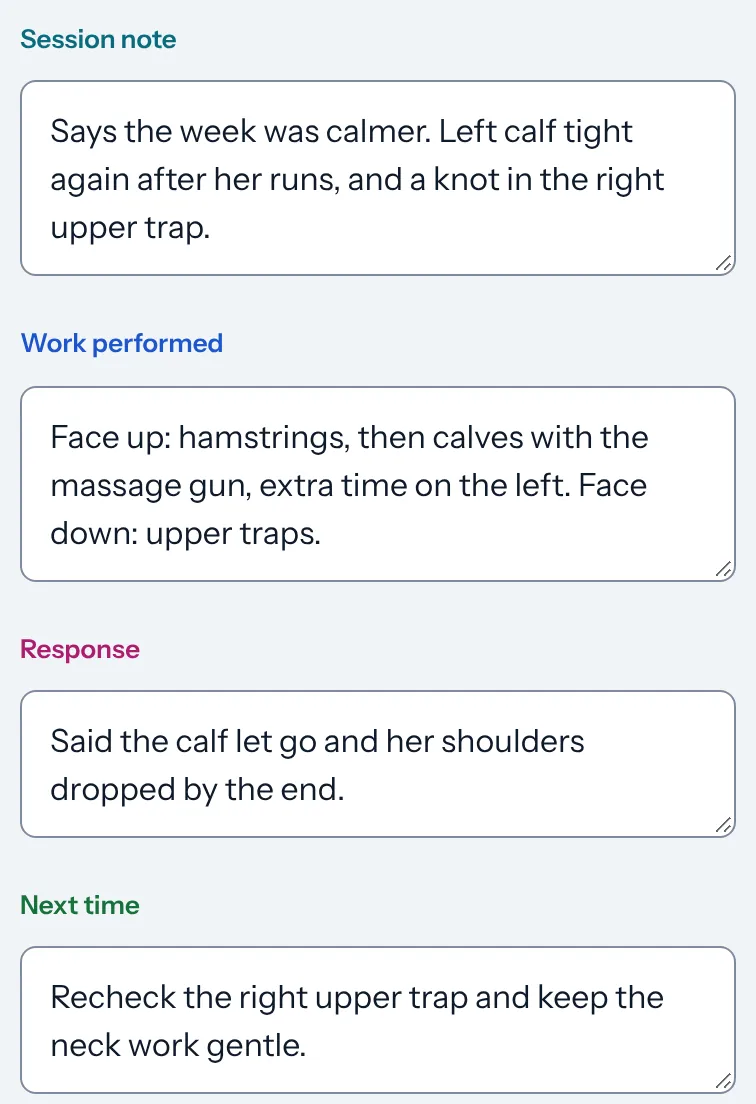
Dorsova’s note is these four parts with plain names. Talk for a minute or type four short boxes after the session, and it checks Work performed against the client’s avoid list before you save. When Dorsova AI drafts the note from what you said, it only organizes your words. It doesn’t add findings, diagnoses or outcomes, and every draft is labelled for you to read before you save.
Sources
- SOAP Notes, StatPearls, NCBI Bookshelf
- Massage Therapy SOAP Notes, American Massage Therapy Association
- SOAP Charting, Massage & Bodywork, ABMP (2021)
- Role and Scope of Practice for the Personal Trainer, ACE Personal Trainer Manual, 5th ed., Chapter 1, American Council on Exercise
- Ohio Administrative Code 4731-1-05, Scope of practice: massage therapy