In this guide
If you’re a massage therapist, good notes do two jobs. The next session starts from what you already know. And they show the work was planned: somebody reading them can tell you weren’t guessing. Below is what to record before and after each session, what the professional bodies and boards say, and how to keep every line inside your scope. Your board and your training come first; this page covers the note.
What the professional bodies say
The American Massage Therapy Association describes SOAP notes as the way to record a client’s condition and progress from intake onward [1]. ABMP’s own magazine makes the same case for charting, and mentions the profession’s worry that many therapists aren’t sure what each section is for [2].
Your state board sets the actual rules, and they differ. The Mississippi board, for example, says therapists must keep accurate, current records of a client’s condition before and after sessions when treating a specific condition [3]. Look up your own board’s page. If it’s stricter than anything on this page, go with the board.
Before the first session: intake and history
Everything you write later builds on the intake. Keep it short enough that clients actually fill it in.
- Health history, as the client reports it. Past injuries, surgeries and when they happened, current conditions, and the medications they take, as they name them. You write them down because some change the session (a blood thinner means lighter pressure); what they take and when is between them and their prescriber.
- What they want. “Neck and shoulders after desk work” is a goal. Write it in their words.
- Pressure preference, and any areas they don’t want touched.
- Who else is involved. If a doctor or physical therapist is treating them, note it, and note anything they’ve been told to avoid.
Write history the way it was reported: “Client reports a herniated disc, low back, 2023.” That keeps the diagnosis theirs and their clinician’s, not yours.
The full form, question by question, is the massage intake form; how to keep each injury entry useful over years is in recording a client’s injury history.
Before every session: what changed
Ask, and write the answers down.
- Anything new since last time? New injuries, procedures, medications, pregnancy.
- How did they feel after the last session? Sore for a day, fine, a headache that evening.
- How are they today? What hurts, where, and how much, in their words. Pain is client-reported, so write it that way: “Rates right shoulder 5/10 today.”
- Anything to avoid today? A fresh bruise, a sunburn, a spot that’s tender to touch.
After every session: the note
Stick to what you did, what you saw and what they said.
- Areas worked and techniques used. “Upper back, neck, shoulders. Swedish, some trigger-point work on the right upper trap.”
- Pressure. “Medium, lighter on the left side of the neck at client’s request.”
- What you observed. “Right upper trap noticeably tighter than left. Limited turning of the head to the right.”
- What the client said, during and after. “Said the neck felt easier turning right by the end.”
- Areas you avoided, and why. “Avoided the left calf: client reports a bruise from a fall last week.”
- Next time. One or two lines. “Recheck right upper trap. Ask about the bruise.”
One habit that helps any hands-on practitioner: write the work in the order you did it, with the client’s position for each part (face up, face down, seated). Whoever sees the client next can follow the same sequence, and you can see when a client turned over more than they needed to. Why that matters, especially with older or injured clients, is in assisted stretch session notes.
A thin note and a good one
The thin one:
Back and neck. Client happy.
And a good one, written right after:
- Client reports: Neck stiff after a long week at the desk, right side worse, 4/10. No changes to health history.
- Work done: 60 minutes. Back, neck, shoulders. Medium pressure, lighter on the right neck. Avoided the low back per the client’s request.
- Observed: Right upper trap and levator tighter than left. Turning the head right limited at the start, easier by the end.
- Client said: “Much looser.” Mild tenderness at the right shoulder blade.
- Next time: Start with the right side of the neck. Ask how the desk week went.
If your studio or board wants it in SOAP form, five sessions written out that way are in massage SOAP note examples.
Staying in scope
Scope rules vary by state, but they all look roughly the same. ABMP’s guidance points therapists first to their state board’s laws and rules, and to the Federation of State Massage Therapy Boards’ model practice act for the general picture [4]. Ohio’s rule, as one example, says plainly that a massage therapist shall not diagnose a patient’s condition, and limits the inquiry to things like questions, looking, range of motion and touch, with referral to a licensed health care professional where needed [5].
On the page, that comes down to a few habits.
- Write what you see, and leave out what it means medically. “Swelling around the right ankle” is an observation. “Sprained ankle” is a diagnosis, unless the client reported it as one.
- Write what the client reports as theirs. “Client says their doctor called it tendinitis.”
- Don’t promise outcomes. “Client said it felt looser” is a record. “Fixed the shoulder” isn’t.
- Write down referrals. “Suggested client ask their doctor about the numbness in the hand.” Then follow up next session.
Where Dorsova fits
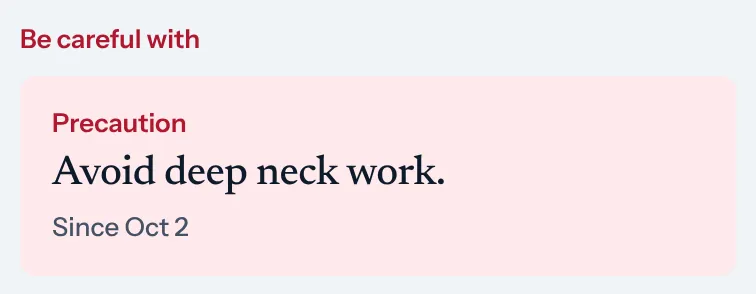
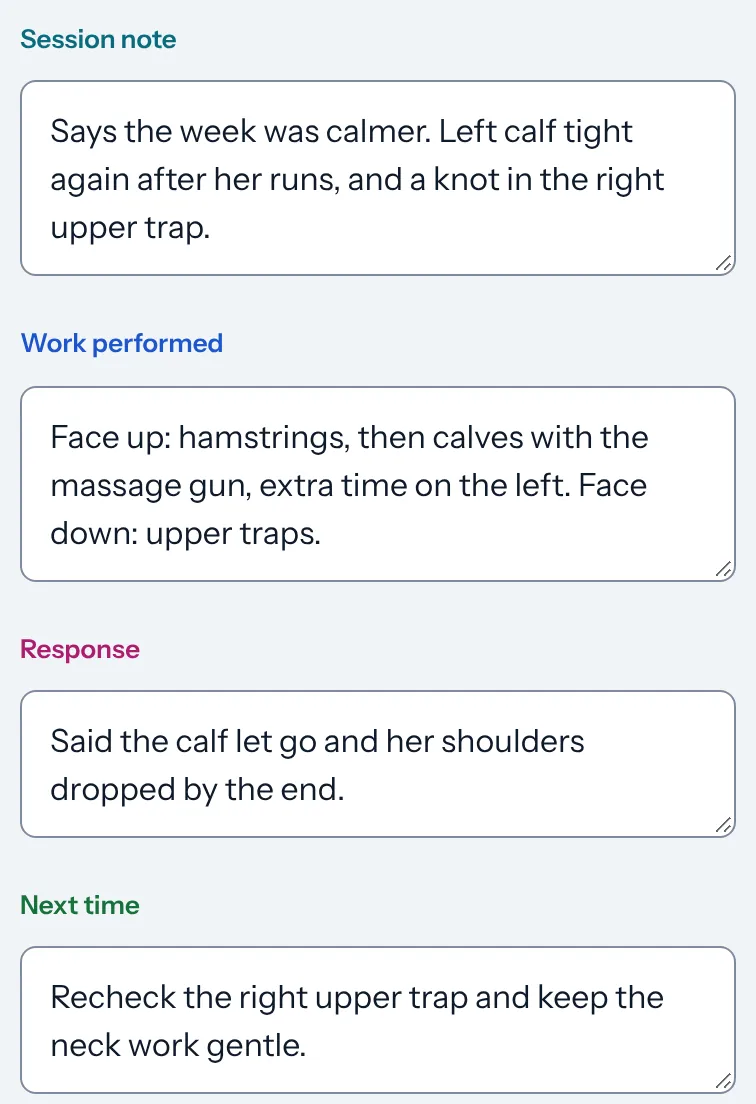
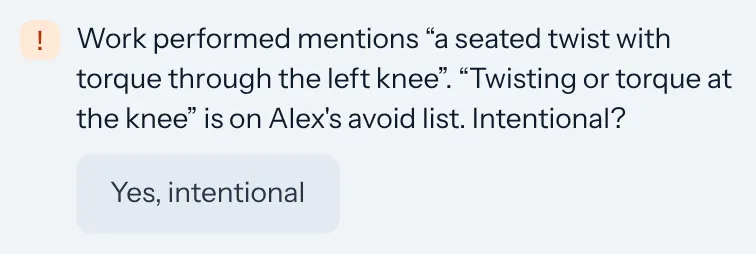
Dorsova shows you a 30-second brief before each session, with injuries and what to avoid first, then last time’s note. Afterwards you talk for a minute or type four short boxes, and it checks the note against the avoid list before you save (“Intentional?”). It sits beside your booking software.