In this guide
Here’s the note I’d hand a new trainer: a blank to copy, then three filled in. It sits beside the training log, not in place of it. The log holds the sets, reps and loads; the note holds what the log can’t, which is how the client came in, every change you made and why, how hard it felt, and what’s next. Why the note matters next to the log is in personal trainer session notes.
The template
Training note | PRECAUTION: (anything on their avoid list, or leave this part out) | GOAL: (the reason they train, in their words) | CAME IN: (sleep, soreness, anything new, in their words) | WORK: (exercises in order, sets x reps at load, and every swap with its reason) | EFFORT: (how hard it felt to them, on your scale, and what you saw) | NEXT: (what to start with, what to progress, what to ask)
One paragraph, plain keyboard characters, so it pastes into any booking software or training app’s notes box. Rename the labels to whatever your gym already uses; the order is the part that matters.
What goes on each line
- PRECAUTION. The client’s avoid lines, written as movements: “No deep knee flexion under load, left knee.” Only what’s on their list. Checking a program against it is in personal trainers and client injuries.
- GOAL. The wedding, the ski trip, getting up off the floor without help. It goes near the top so the program keeps turning back to it on the weeks you’re training around something.
- CAME IN. What they told you at the start. “Says hamstrings sore for two days after Monday. Slept badly.” Pain or soreness only as theirs.
- WORK. The exercises in order with sets, reps and load. If you keep a training log, you can shorten this to the main lifts. Never shorten the swaps: “Step-ups in place of lunges, left knee didn’t like them last week.”
- EFFORT. How hard it felt to them, on whatever scale your gym uses, and what you saw. “Rated the squats 7 of 10. Knees drifted in on the last two reps.”
- NEXT. One or two specific things. “Keep goblet squat at 35 until the knees stay out. Ask about Saturday’s tennis.”
Three examples
Made-up clients.
A first session
Training note | PRECAUTION: None reported | GOAL: Says she wants to hike with her daughter this summer without her knees aching on the way down | CAME IN: First session. PAR-Q+ done, all no. Says she walks 30 min most days, hasn’t lifted before | WORK: Bike 6 min. Box squat 2x8 bodyweight. Incline push-up 2x8 on the bench. Band row 2x12. Glute bridge 2x10. Farmer carry 2x30 m at 2x15 lb | EFFORT: Said it all felt about a 5 of 10. Squat depth to the box fine, needed a cue to push knees out | NEXT: Add step-downs from a low box. Ask how her knees felt the next day
A regular
Training note | GOAL: Ski trip in four weeks | CAME IN: Says hamstrings sore for two days after Monday, now fine. Slept badly. Left knee fine | WORK: Bike 8 min. Goblet squat 3x8 at 35 lb. Step-ups 3x8 each leg to a 16 in box. RDL 3x10 at 2x25 lb. Dead bug 3x10 | EFFORT: Rated the squats 7 of 10. Knees drifted in on the last two reps of each set | NEXT: Keep goblet squat at 35 until the knees stay out on every rep. Start lateral lunges next week
A session built around a sore knee
Training note | PRECAUTION: No deep knee flexion under load, left knee | GOAL: Ski trip in three weeks | CAME IN: Says left knee sore since Saturday’s tennis, 3/10 going downstairs. Hasn’t seen anyone about it | WORK: Bike 8 min. Box squat to a high box 3x8 at 25 lb (in place of goblet squat to depth). Hip thrust 3x10 at 95 lb. Single-leg RDL 3x8 each side. Pallof press 3x10. Dropped step-ups today | EFFORT: Rated it 6 of 10. Said no knee pain on the high box squat | NEXT: Ask about the knee first. If it’s still sore, suggest they get it looked at before we load it again
The third note is the one that earns its keep. Next week, whoever trains them knows the step-ups came out on purpose and why, and that the knee question comes first. When a sore knee or anything else is beyond what you do, the note says you suggested they see someone, not what you think it is. More on that line in when to refer a client out.
What to keep out
- Diagnoses. “Says knee sore after tennis” is yours to write. A name for it isn’t, unless their clinician gave it to them, and then say so. ACE puts diagnosing outside a personal trainer’s scope [1].
- Rehab you’re running. If a PT is treating them, the PT’s plan comes first and your program fits around it. Write down what the PT said, not your plan for their injury.
- Treatment for pain. NASM’s handbook says trainers don’t diagnose or treat pain or disease [2]. Write what you changed in the session and what you suggested.
Common questions
What should personal trainers write in client notes?
How the client came in, what you did with every change and its reason, how hard it felt to them, and what to start with or ask next time. Keep their goal and their avoid lines at the top, so every session is planned around both.
Do personal trainers need a note if they already keep a training log?
Yes, a short one. The log holds sets, reps and loads. The note holds the why: a swap for a sore knee, a client who slept badly, a goal that’s three weeks away. That’s what the next session needs.
Should a personal trainer use SOAP notes?
You can, but you don’t have to. The same information fits in plain parts that read faster, and they keep the assessment from sounding like a diagnosis. The comparison is in SOAP notes for non-clinicians.
Where Dorsova fits
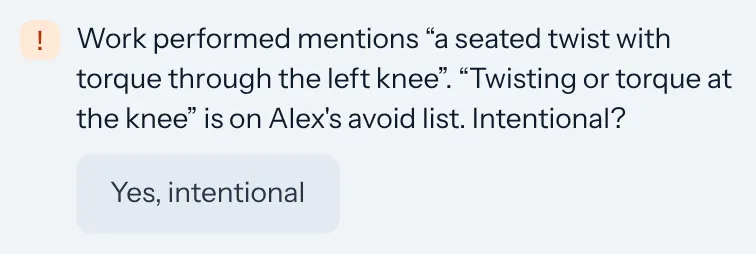
Dorsova keeps each client’s goal, injuries and avoid list in a 30-second brief before the session, with last time’s Next as today’s plan. After the session you talk or type the note in about a minute, and if the work you describe matches something on the avoid list, it asks “Intentional?” before you save. It never blocks the save. The note copies as one plain paragraph, ready to paste.