In this guide
“Firm” means something different to every client. One person’s firm is your medium. Another’s firm is the reason they left their last therapist. If the note just says “firm pressure,” the next practitioner is guessing, and the client finds out in the first two minutes whether they guessed right.
Preferences are small details, and they’re the ones clients notice most. Get them down properly once and every session starts better.
Ask, then keep asking
AMTA’s guidance for massage clients is that they have the right to agree to the techniques and the pressure used, and to ask for changes at any point during the session [1]. Their article on educating clients says to agree up front how much discomfort is okay, and to check in on pressure as you go [2].
So the first answer is a starting point, not a setting.
- At the start: “Do you like it lighter, medium or firmer?”
- The first time you go deeper: “How’s that? More, less, or right there?”
- At the end: “Was the pressure right today?”
A Cleveland Clinic article, from a massage therapist on their team, puts the reason plainly: a therapist can adjust the work but can’t feel the intensity of the client’s response [3]. The only way to know is to ask.
Write their words, then what you did
Two things go in the note: what the client said, and what you actually did. They’re not always the same.
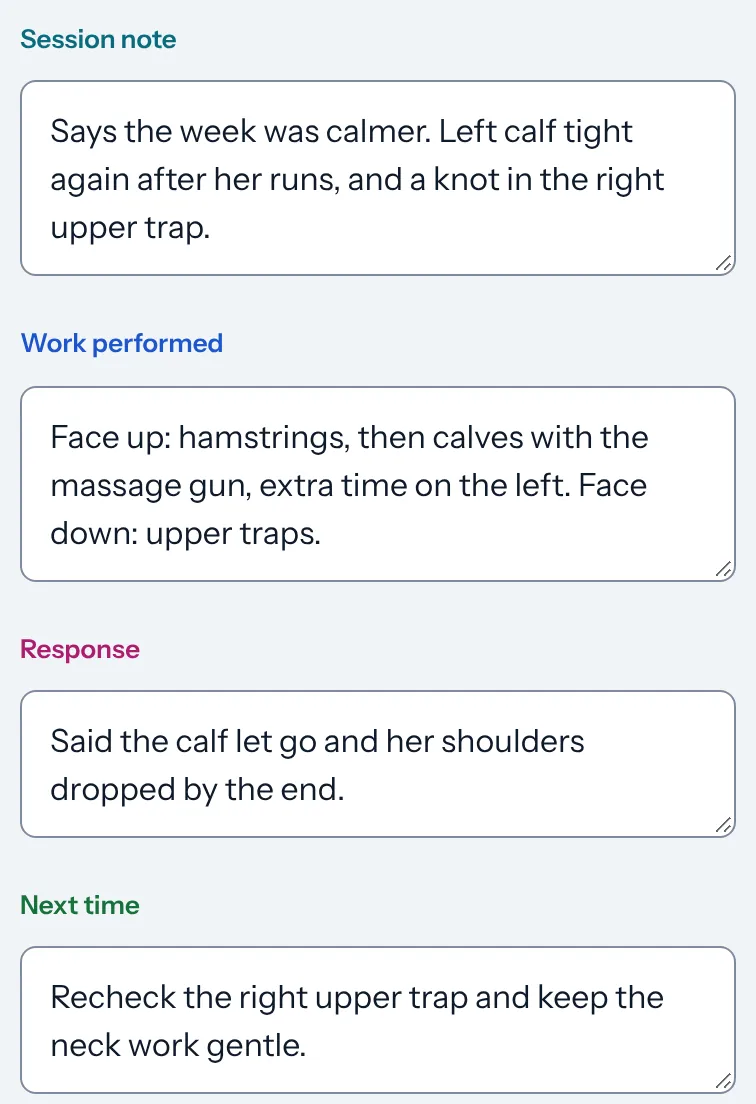
A thin note:
Firm pressure.
A good one:
Note: Asked for “firm, I like it deep” at the start. Work: Medium-firm on the back and hips; asked to go lighter on the left upper trap (“too much there”). Response: Said the pressure was “just right” by the end. Next: Start medium-firm, lighter on the left upper trap.
Now the next person knows what “firm” means for this client, where the exception is, and how it went.
Write the client’s own words in quotes when they’re useful. “Not too deep, I bruise easily” tells the next person more than “light.”
Comfort, not only pressure
Pressure gets asked about. The rest often doesn’t, and it’s what makes a session feel looked after.
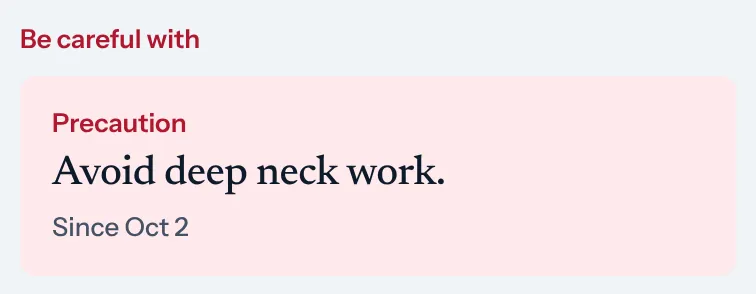
- Areas they don’t want touched. Feet, face, neck, stomach. These go on the avoid list, written as areas or movements. “No work on the feet.”
- Position. “Prefers to start face down.” “Doesn’t like lying flat for long; a bolster under the knees.”
- Temperature. “Runs cold, extra blanket.”
- Talk or quiet. “Likes to chat at the start, quiet after.” It’s a preference like any other.
- Anything else they mention. Music off, the lights low, no scented oil.
None of these needs a paragraph. One short line each, and only the ones that are true for this client.
Keep it current
Preferences change. A client who wanted it deep in March may want it lighter after a hard month, a new medication or a fall. If they take something that changes how you work (a blood thinner can mean lighter pressure), write it down the way they name it. What they take and when is between them and their doctor.
When a preference changes, update it the same day, and say when. “Since Nov: prefers lighter on the low back.” The old one doesn’t need deleting. The date tells the next person which one is current.
Don’t promise what pressure will do
Write what the client asked for and what they said afterwards. Don’t write, or say, what the pressure is supposed to achieve.
- Fine: “Asked for deeper work on the hamstrings. Said they felt looser after.”
- Not ours: “Deep pressure to break up the knots.” “Firmer pressure will fix the shoulder.”
The client’s experience is the record. “Said it felt easier” is honest. “Released the adhesion” is a claim you can’t back up. Massage therapy session notes has more on keeping every line in scope.
When a client says the last session was too much, what to ask and how to write it down is in when a client says they felt worse after a session.
Where Dorsova fits
In Dorsova, pressure goes in the note in a short line, and it comes back in the next brief as last time’s note, whoever the client books with. Areas they don’t want touched go on their avoid list, which every brief shows first, and the note check asks “Intentional?” if the work you describe matches one.