In this guide
A new client is on the table, or about to be, and you’ve got maybe five minutes before the session starts. That’s enough. Don’t read a questionnaire out loud. The consultation is a conversation, and it has two jobs: how not to hurt them today, and what they actually came in for.
Ask the same handful of things every time, in roughly the same order. Then write it down so the next person who works on them can read it in thirty seconds. (If you want the questions on paper for the client to fill in first, they’re in a client intake form for assisted stretching.)
Start with why they’re here
The first question is the big one. What brought you in? Call it the macro goal. “My back’s been tight since I started working from home.” “I want to keep playing golf without my hip complaining.” “My PT discharged me and I don’t want to lose what I got back.”
Write it in their words. It’s the thing they’ll judge every session against, and the thing you’ll come back to when they ask whether this is working. Then there’s the micro issue, whatever’s bugging them today. A client who tweaked their back shoveling the driveway this morning still has the same macro goal. They just need today’s session to deal with the back first.
Open questions work better than a checklist here. ABMP’s guidance on taking a history is to start open and then probe for detail [1]. “Tell me what’s been going on” gets you more than “Any pain? Yes or no.”
Injuries and surgeries, with when
Ask about every injury and every surgery, and ask when. The when matters as much as the what. A hip replacement three years ago and one three months ago are different sessions.
ABMP’s code of ethics asks members to take a thorough health history from every client and use it to rule out contraindications or adapt the session [3]. You don’t need a twelve-page form for that. You need the right questions and a place to write the answers.
What goes on the record:
- What it was, in their words. “Client reports a torn rotator cuff, right shoulder.” Not your guess at what it was.
- Which side.
- When. Month and year at least.
- Is it still being treated? Still in PT, still seeing the surgeon, or done.
If they’re still in rehab, their PT’s plan comes first and your work fits around it. A recent operation gets a longer set of questions: working with a client after surgery.
What to write for each one, and how to keep it current for years, is in recording a client’s injury and surgery history.
What they’ve been told
This is the question people skip. What has your surgeon or PT told you to avoid, and for how long? Get it in their words. “No twisting for twelve weeks.” “Don’t kneel on it yet.” If they’ve got a sheet from the clinic, ask them to bring it next time. If a client says their doctor wants them to exercise only under supervision, that’s an answer you write down and work inside.
What they want to avoid
Separate from the medical stuff, ask what they don’t want. Some people hate having their feet touched. Some don’t want their neck worked on at all. Some had someone dig into their IT band once and don’t want that again. These go on the avoid list too, written as movements or areas. “No work on the feet.” “Avoid aggressive neck work.” (How to word an avoid list.)
How they like pressure
Ask, and then keep asking during the session. AMTA’s guidance for clients is that they have the right to agree to the techniques and the pressure used, and to ask for changes at any point during the session [4]. Their article on educating clients says to agree with the client up front on how much discomfort is okay, and to check in on pressure during the session [2].
“Light, medium or firm” at the start, then a check-in the first time you move into anything deeper. People say “firm” and mean very different things.
How to write the answer down so it stays useful, in the client’s words beside what you did, is in pressure and comfort preferences. For massage clients, the questions on paper are in the massage intake form.
Writing it up for the next practitioner
This is where most first sessions fall apart. You remember it, the client books with someone else next week, and none of it carried over.
A good intake note can be read in thirty seconds by someone who’s never met the client. Put it in this order:
- Why they’re here. One line, their words.
- Cautions. Every injury and surgery with side and date, and what the surgeon or PT said to avoid.
- Avoid list. Movements, written plainly. “Twisting or torque at the left knee.” Not “bad knee.”
- Pressure. What they said, and anything you learned once you started.
- What you did today, in order, with the position. Face up, hamstrings and calves. Then glutes. Then face down for the upper traps. The next person should be able to read the session back.
Record what the client told you as what the client told you. “Client reports a herniated disc at L5” is fine. You writing “herniated disc” as if you found it isn’t. ACE tells trainers flat out that diagnosing is outside their scope [5], and the same line holds for anyone hands-on who isn’t the client’s clinician.
And reread it before the second session. The intake isn’t done after the first visit. People remember things later, like the shoulder surgery from fifteen years ago they forgot to mention, and the record should grow with them.
Where Dorsova fits
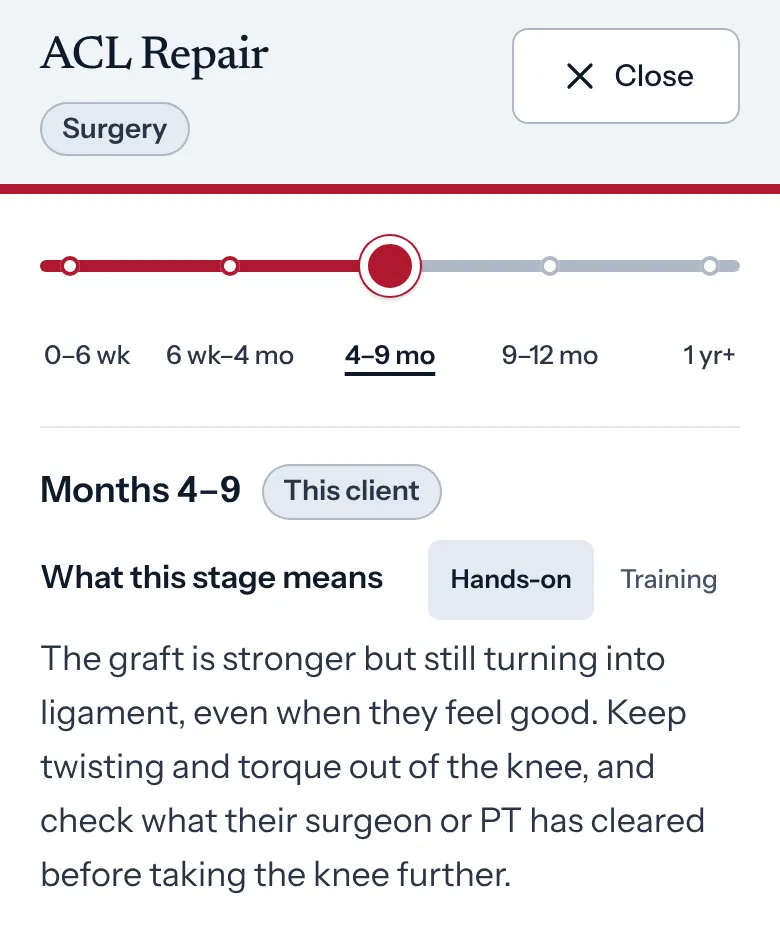
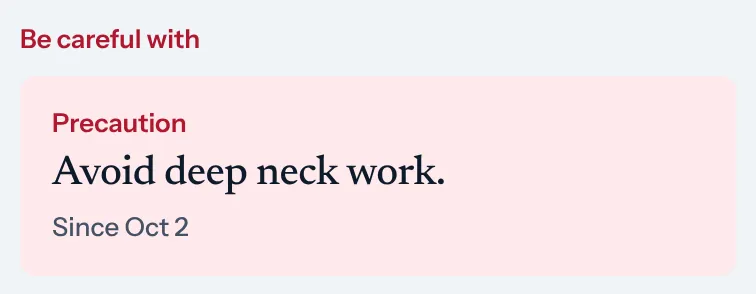
In Dorsova you pick an injury or surgery from 104 researched ones and say when it was, and it suggests what to avoid and a caution level for that stage. Your recommendation decides. Every brief then shows those cautions first, along with why they’re here, so the next practitioner sees the same thing you did.
Sources
- Capturing Clues: The Power of the History, Massage & Bodywork, ABMP (2023)
- Educating Massage Clients, American Massage Therapy Association
- ABMP’s Code of Ethics for Massage Therapists, Associated Bodywork & Massage Professionals
- What Should Someone Expect From Their Massage and Massage Therapist?, American Massage Therapy Association (2017)
- Role and Scope of Practice for the Personal Trainer, ACE Personal Trainer Manual, 5th ed., Chapter 1, American Council on Exercise