Most intake forms are either one page of tick boxes nobody reads or six pages nobody finishes. For assisted stretching you need less than you think, and you need it written in a way that changes the session.
Here’s the form, question by question, with why each one is there. The conversation around it, and how to write it up afterwards, is in the first session with a new client.
The questions
Why they’re here
- What brought you in? Open, in their words. “Tight hips from sitting all day.” “I want to keep playing tennis.” This is the macro goal, the line every session comes back to.
- Is there anything bothering you right now? Where, and how much, as they’d put it.
Injuries and surgeries
- Any injuries or surgeries, ever? For each one: what it was, which side, and when. Month and year if they know it. The when matters as much as the what. A knee replacement five years ago and one five months ago are different sessions.
- Are you still being treated for any of them? Still in PT, still seeing the surgeon, or done.
- Has a doctor or physical therapist told you to avoid anything, or limit anything? In their words, with how long for if they know. “No twisting for twelve weeks.”
ABMP’s code of ethics asks its members to take a thorough health history from every client and use it to adapt the session or rule out work [1]. These three questions are the core of that for a stretch client.
Health
- Any conditions you’d like me to know about? Leave space to write. Then, by name, because people don’t think to mention them: osteoporosis or low bone density, high or low blood pressure, dizziness when standing up, pregnancy, anything with the nerves (numbness, tingling).
- What medications do you take? As they name them, aspirin included. Some change how you work, like lighter pressure for someone on a blood thinner. What they take is between them and their doctor, and the form just records it.
- Any falls in the last year? Mostly for older clients, and worth asking everyone.
That’s close to the minimum most intake guidance covers: surgeries, medical conditions, current medications, injuries, pain, skin conditions, allergies and sensitive areas [2].
How they like it
- How strong do you like a stretch? Gentle, medium, strong, or a number on whatever scale your studio uses. Still check during the session, because people mean very different things by “strong”.
- Anywhere you don’t want worked? Feet, neck, anything. No reason needed.
- Anything that’s made a session go badly before? One honest line here saves a lot.
For trainers
If they’re also going to train with you, the PAR-Q+ is the standard screen. It opens with seven general health questions, and a yes sends them to follow-up questions or to their health care provider before they start [3]. Put it alongside the questions above, not instead of them. How screening fits into a trainer’s injury tracking is in keeping track of client injuries.
What to leave off
- Anything you won’t use. If nobody’s going to act on “favorite color of towel”, it’s just one more reason not to finish the form.
- Medical tick boxes you can’t interpret. A form full of conditions you don’t know what to do with gives you a page of answers and no plan. Ask open, ask the few by name, and when an answer is outside what you know, ask the client to check with their doctor before you work on that area.
- Questions that sound like diagnosis. “Do you have sciatica?” invites a guess. “Any pain or tingling down the leg?” gets what they actually feel, in their words.
Then get it into the record
A filled-in form in a drawer helps nobody. Before the first session ends, the answers go into the client’s record: why they’re here, each injury and surgery with side and date as they reported it, the avoid list written as movements (writing avoid lists), what they’ve been cleared for, by whom and when, and how they like it. The order that reads in thirty seconds is in the first session with a new client.
Then ask again. People remember things later, and a form filled in once goes stale. Check what’s new before every session (what to check before a session) and update the record that day.
Where Dorsova fits
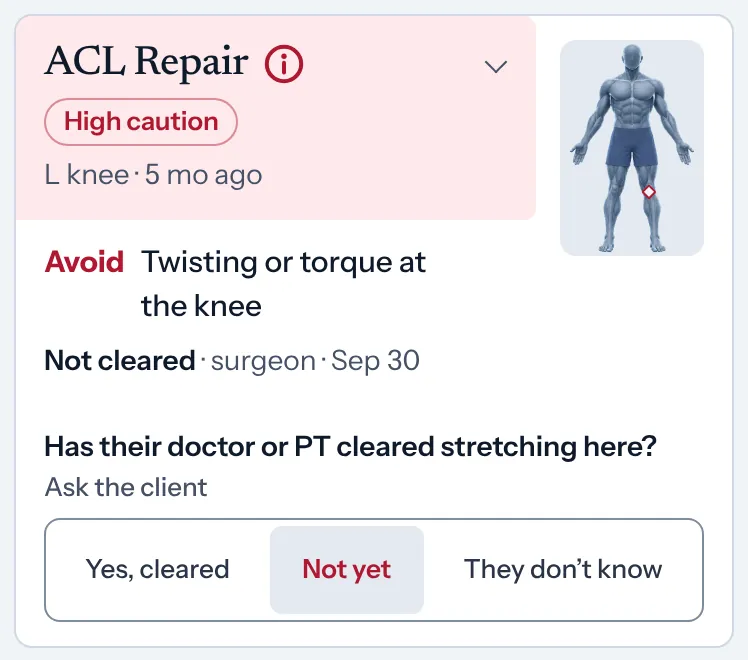
In Dorsova you add each injury or surgery to the client’s profile by picking it from a library of 104 researched injuries and surgeries (or typing it as the client said it) and saying when it was. It suggests avoid lines and a caution level for that stage, and your recommendation decides. From then on, every brief shows them first, with the clearance answer and the date, to whoever the client books with.