In this guide
A client sits down and says, “Honestly, I felt worse after last time.” Your stomach drops a little. It shouldn’t, or at least not for long. It isn’t a verdict on you. It’s information, and it’s some of the most useful information you’ll get all week, because now you know something about this person that you didn’t know before.
What matters is what you do with the next two minutes: ask, listen, write it down the way they said it, and change today’s session to fit.
Ask before you explain
The instinct is to reassure straight away. “Oh, that’s normal.” Maybe it is. You don’t know yet. Ask first, in plain words, and let them finish.
- “What did it feel like?” Sore, achy, stiff, something else. Let them pick the word.
- “Where?” Which side, which area.
- “When did it start, and how long did it last?” That evening, the next morning, still now.
- “How is it today?” Gone, better, the same.
- “Anything else happen since?” A long drive, a heavy weekend in the garden, a new class at the gym.
That last question matters more than people think. Bodies don’t only react to us. The client who felt worse may also have moved house on Saturday.
Write it in their words
Pain is only ever what the client reports, and so is “worse.” Write what they said, not what you think it was.
A thin note:
Client sore after last session.
It isn’t wrong. But it doesn’t say where, how long, or what anyone should do about it.
A good one:
Came in: Says she felt “really achy” in the right side of the low back the evening after last session, lasted until the next afternoon, gone now. Moved boxes on Sunday. Work: Lighter pressure on the right low back, no deep work there today. Response: Said today felt “much easier” by the end. Next: Ask how the back was the day after today’s session.
Notice what isn’t in it. No guess at the cause, no “probably a pulled muscle,” no “inflammation.” You don’t know, and writing it down makes it look like you do.
What to say
Expectations, never advice. You can tell a client what’s common. You can’t tell them what it was or what to take for it.
Cleveland Clinic’s article on soreness after massage, from a massage therapist on their team, compares it to the soreness after a workout and says it usually lasts a few hours to about a day and a half [1]. That’s a reasonable thing to pass on, framed as what’s common, not as a promise.
A few lines that work:
- “Thanks for telling me. That helps me get it right.”
- “Some people feel a bit sore for a day after deeper work, a bit like after a workout. I’d rather you didn’t, so let’s go lighter today.”
- “Tell me during if anything feels like too much. I can’t feel what you feel, so I need you to say.”
That last one comes straight from the same article: the therapist can adjust the work but can’t feel the intensity of the client’s response [1]. AMTA’s guidance for massage clients says the same from the other side: they can agree to the pressure and ask for changes at any point [2].
What not to say: “That’s just toxins leaving.” “That means it’s working.” “You’ll feel better after a few more.” None of those is ours to promise.
Change today, and say so
Don’t run the same session again and hope. Something has to be different, and the client should hear what.
- Go lighter on the area they named, and check in the first time you get near it.
- Shorter holds or fewer passes there, if that’s how you work.
- Ask afterwards. “How did that feel compared with last time?” Write the answer down.
Then put what you changed in the note, so the next practitioner doesn’t undo it on Saturday.
When it doesn’t sound like soreness
Most of the time, this is a day of ordinary soreness and a lighter session fixes it. Sometimes what they describe doesn’t sound like that, or it’s still going, or it’s getting worse. That’s not ours to work out. Cleveland Clinic’s piece itself says to see a healthcare provider if intense soreness lasts longer than a couple of days [1]. NASM’s handbook is clear for trainers that we don’t diagnose or treat pain, and we refer clients with those needs to health care professionals [3].
Say it calmly, the same way as any referral:
- “I want to make sure I’m helping and not getting in the way. Can you check this with your doctor before we work on that area again?”
- “Today let’s leave the low back alone and work on the hips and legs.”
- “Let me know what they say and we’ll pick it up from there.”
Then write down what they reported, what you suggested and what you did and didn’t work on. When to refer out has the full wording and what to note.
A line for next time
The most important line in this note is the last one. Whoever sees the client next needs to ask about it, whether that’s you or someone else.
- “Ask how the right low back felt the day after.”
- “Lighter on the right low back until she says it’s fine.”
- “Asked her to check the low back with her doctor. Ask what they said.”
When the client says it’s fine, write that too. “Says no soreness after last session.” That line is the end of the story, and it’s worth having on the record.
Where Dorsova fits
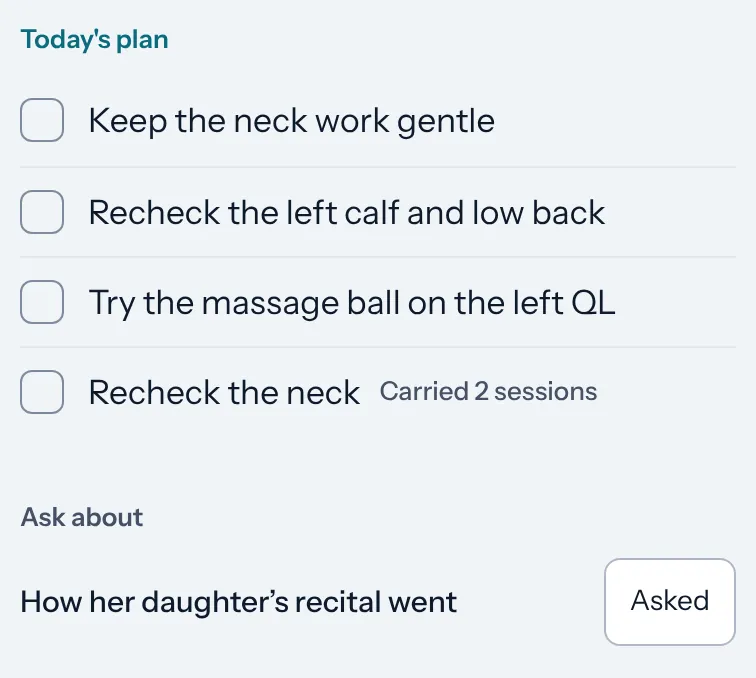
In Dorsova, write what the client told you in the Session note box, in their words, and put the follow-up in Next time. It comes back at the top of their next brief as Plan for today, in front of whoever they book with, so the question gets asked even if you’re off that day.