In this guide
Plenty of the people on a hands-on practitioner’s book are in their sixties, seventies and up. They need a slightly different session, and most of the difference is in everything around the stretching. How they get onto the table, how many times they turn over, how fast they stand up at the end.
This is how to run a session for an older client. None of it is medical advice, and none of it replaces what their doctor has told them. It’s about not creating a problem while you’re helping with the one they came in for.
Getting on and off the table
Go slow, and let them set the pace. Lower the table if you can. Stand close without grabbing. Tell them what’s next before it happens, like “we’re going to sit up now, take your time.”
Falls are the reason to care about this. CDC says more than one in four older adults falls each year, and plenty of them never mention it to their doctor [1]. So ask at the intake whether they’ve had a fall recently, and write down what they say. A client who’s fallen twice this year gets a different exit from the table than one who hasn’t.
Plan the session so they turn over once
This is my preference for every client, and for older clients I treat it as a rule. Plan the work so they turn over at most once. Face up for everything you’re doing face up, then one turn, then face down for the rest. Or the other way round.
Avoid face up, face down, face up again, face down again. That’s a janky session for anyone. For someone with a stiff back or a new hip, every turn is effort and a chance to tweak something. If you’ve only got one turn, you think about the order before they lie down, and the session flows better anyway.
Some clients shouldn’t go face down at all. Ask. Plenty of older clients will tell you they can’t lie on their stomach anymore, and side-lying or seated work does the job.
Dizziness when they stand up
Somebody’s been lying down for fifty minutes, relaxed, and then they sit up and stand straight away. That’s when the room spins.
Mayo Clinic describes orthostatic hypotension as a drop in blood pressure when someone stands up after sitting or lying down, with lightheadedness or dizziness on standing as the most common symptom [2]. It’s common in people 65 and older, and some medications, including blood pressure drugs, raise the risk [2]. That’s a reason to sit them up slowly and wait, not a reason to say anything about the medication: questions about it go to their doctor.
CDC’s STEADI material for patients lays out getting up in stages. Sit up first, then sit on the side of the bed, then stand, holding on to something steady [3]. It also suggests moving the feet up and down a few times before getting up [3]. That translates straight to the table. Have them sit on the edge for a moment, feet on the floor, and stay right there until they’re steady.
If a client tells you this happens to them a lot, or they’ve fainted, that’s for their doctor. Write down what they said and suggest they bring it up at their next appointment.
Skin and pressure
Older skin is thinner, and the blood vessels under it are more fragile. The National Institute on Aging says that’s why older adults bruise more easily, and why bruises can take longer to heal [4]. AMTA’s article on massage and the aging body says the same about the skin: it tears more easily and heals more slowly [5]. So ease off the downward pressure and the dragging strokes.
In practice:
- Start lighter than you would with a 35-year-old and build up only if they ask.
- Check in more, and actually wait for the answer. Some older clients won’t tell you it hurts unless you ask directly.
- Watch the skin where you’re working, especially over shins and forearms.
- Keep friction low. Less dragging, more broad contact.
Bones and blood thinners: ask, record, check
Ask about these two by name, every time, because they change how hard you can press and the client might not think to mention them.
Osteoporosis or low bone density. Ask if they’ve ever been told they have it. ABMP’s article on endangerment sites notes that forceful work over the spine and other bony points can cause injury, especially when something like osteoporosis has already weakened the bone [6]. I don’t press on the spine or on bony points with anyone, whatever their age. With osteoporosis it matters even more. You aren’t assessing their bones. You’re asking, writing down what they tell you, and if they’ve been told it’s severe or they’re not sure what’s safe, suggesting they check with their doctor before you go deeper.
Blood thinners. Ask what medications they take, including aspirin. MedlinePlus lists blood thinners like aspirin, warfarin and clopidogrel among the things that make bruising more likely [7]. Knowing they take one changes your pressure; it doesn’t change anything about the medicine, which is their doctor’s. Write it down with the date, and keep pressure light unless their doctor has told them otherwise.
Ask about both again every few months. Medications change. People get new diagnoses and don’t think to tell their stretch practitioner.
Checking in
Check in more often with older clients, and keep the questions simple. “How’s that?” “Too much?” “Want me to ease off?” At the end, before they stand, “how do you feel?” If they say they’re a bit lightheaded, they sit longer.
And the next session, ask how they felt afterwards. Any soreness that lasted, any bruising. That goes in the note too.
What goes in the note
- What you asked about and what they told you: falls, osteoporosis, medications, anything their doctor has said.
- What you did, in order, with the position, and the one turn.
- Pressure used, and anything you changed because of how they responded.
- How they got up. “Sat on edge 1 min before standing, steady” tells the next practitioner a lot.
Where Dorsova fits
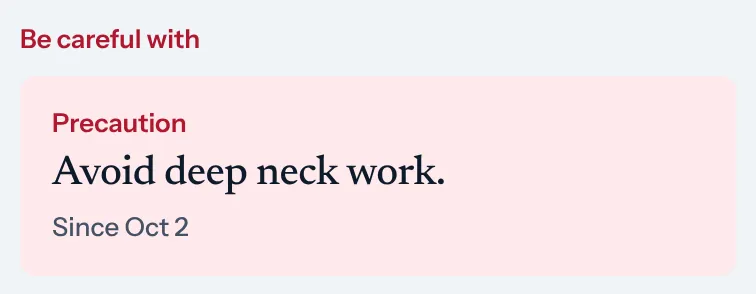
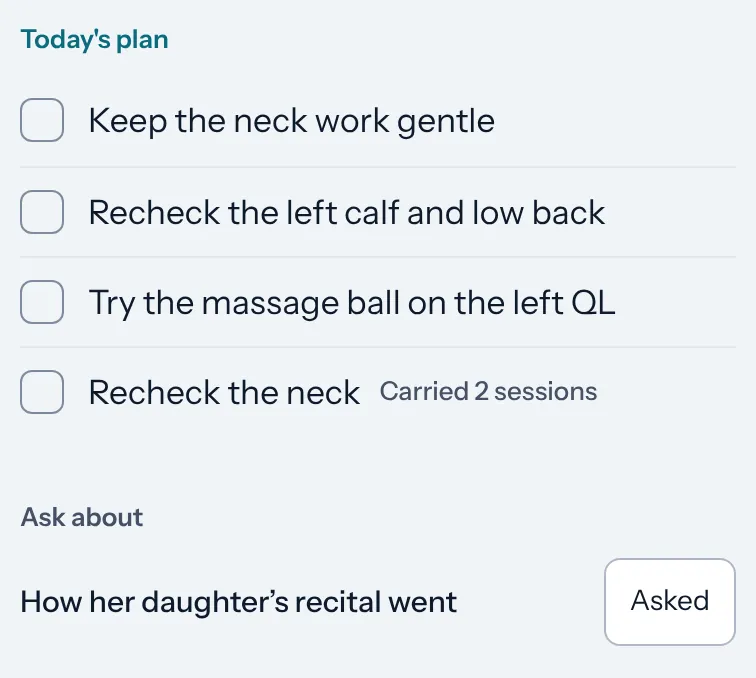
Dorsova’s brief puts a client’s injuries and what to avoid first, in front of whoever they book with, so the newest practitioner sees the same cautions as the one who did the intake. Plan for today brings back what to ask about from the last note, like “ask about the dizziness when standing,” once you keep it when the note offers it, and you tap Asked when you have.
Sources
- Facts About Older Adult Falls, Centers for Disease Control and Prevention
- Orthostatic hypotension (postural hypotension): Symptoms and causes, Mayo Clinic
- Postural Hypotension: What It Is and How to Manage It, CDC STEADI
- Skin Care and Aging, National Institute on Aging
- Massage and the Aging Body, American Massage Therapy Association
- Take the Danger Out of Endangerment Sites, Massage & Bodywork, ABMP (2020)
- Bruise, MedlinePlus Medical Encyclopedia