In this guide
You get five minutes between clients. Either one of them goes to the note, or the note waits until the end of the day, and we all know which one usually wins. A useful note takes under a minute if you write it right after the session. Write it at 7 pm and it takes longer and says less.
Write it now, not tonight
Memory fades fastest right after something happens, then levels off. Ebbinghaus showed this in the 1880s, and a modern one-person replication found the same steep early drop in what is kept over the first hours and the first day [1]. A memory researcher’s review explains why: a new memory is fragile while it settles, and other mental activity in that window disrupts it [2]. Five more clients after this one is a lot of other mental activity.
By 7 pm, the 10 am client’s left calf and the 2 pm client’s right calf have started to run together. Somebody was tight. Who, and which side, is less clear.
Healthcare documentation backs this up. A study of nurses recording events during surgery found errors rose sharply when entries were made late: from about 1% with no delay to more than a third when the entry came more than 20 minutes after the event [3]. Their setting isn’t ours, but the lesson carries straight over.
UK nursing guidance puts it plainly: make records at the time, or as soon as possible after the care or the event [4]. You don’t have to be a nurse to steal a good rule.
Four lines
A good note answers four questions, and each one can be a single line.
- How they are. What the client told you at the start, in their words. “Says lower back stiff after a long drive. Rates it 4/10.” Pain is what the client reports, so write it as theirs.
- What you did, in order. One line per block of work, with the position the client was in. “Face up: hips → low back. Lighter pressure on the left glute. Skipped the lying twist.”
- How they responded. What they said and what you saw. “Said the back felt looser. Left hamstring still tight at the end.”
- Next time. One or two things the next person should do or ask. “Start with the left hamstring. Ask how the drive home was.”
That’s close to the structure a lot of health professions use: what the client reports, what you observe, your read of it, and the plan [5]. Outside a clinic, the four plain questions cover the same ground without anyone reaching for clinical words. If your studio asks for SOAP by name, SOAP notes without the clinical part shows what goes under each letter. Why the order and the position matter so much, with three full stretch examples, is in assisted stretch session notes.
The macro goal and the micro issue
Every client has a macro goal, the reason they came through the door. Then micro issues crop up along the way. They overdid it at the gym, strained something lifting at home, stepped wrong on a stair. Deal with the micro issue right away, because that’s where clients really feel the value. Keep the macro goal in view the whole time so the work doesn’t drift off it.
Take a 50-year-old golfer with an old low-back injury. He wants more rotation and a better game. Then he goes hiking and strains his left calf. For the next few sessions the work is the calf. Golf and rotation are still why he comes.
So the note carries both. The goal sits in his record in his words: “Golf: more rotation, play better, protect the old low-back injury.” The calf goes down the way he reported it, with the side and the date. And Next time names both:
Next: recheck the left calf; back to rotation work for golf once it’s easy.
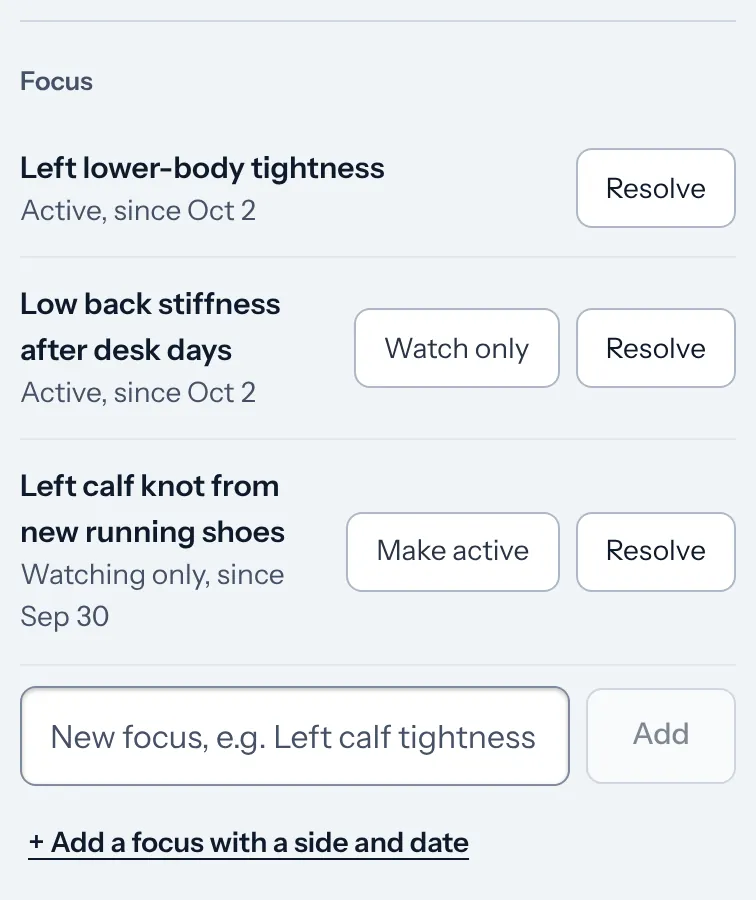
When the calf’s fine, mark it resolved instead of deleting it, so the history stays. Then Next time points back at golf.
What to leave out
A fast note is short because it skips what won’t help the next session.
- Guesses about causes. “Probably from sleeping wrong” doesn’t help anyone next week.
- The whole routine. If you ran your standard sequence, say so in two words and only note what was different.
- Small talk. A recital next weekend is worth one line under Next time. The rest of the chat isn’t.
- Judgements about the person. Stick to what they said and what you saw.
- Diagnoses. “Client says her doctor called it sciatica” is fine; “sciatica” on its own isn’t your call. The full list of clinical words to keep out is in the SOAP guide.
The four lines as one blank to copy, with a filled-in note for stretch, massage, training and mobility, are in the session notes template.
A thin note and a good note
This is a thin note, the kind that gets written at 7 pm:
Full body. Tight hips. Good session.
It isn’t wrong. It just can’t help anybody. Which hip? What was different? What happens next time?
And this one took under a minute, right after the session:
- How they are: Says left knee “a bit achy” after hiking Saturday, 3/10. No new injuries.
- What you did: Face up: hamstrings → hips. Kept off deep knee bending on the left. One turn. Face down: calves → massage gun on calves. Lighter pressure at the left calf.
- How they responded: Said the knee felt fine during. Left calf still tight at the end; right side moved freely.
- Next time: Start with the left calf. Ask how the knee held up after the next hike.
Same session, same client. The second one costs maybe 40 seconds more, and it saves the next practitioner the first five minutes of guessing.
Keeping it under a minute
- Write in the room or at the door, before the next client comes in. Not in between three other jobs.
- Fragments are fine. “Left calf tight” is a complete thought.
- One line per block, in the order you did it, with the position.
- Always the side. Left or right is the first detail to disappear.
- If typing’s slow, talk it. Thirty seconds out loud is often quicker than typing.
- Re-read Next time before you save. That’s the line the next session starts from.
On a day with six clients in a row, the habit needs a fixed moment: writing notes between back-to-back clients is what I do when there are five minutes between each. For owners with several studios, keeping notes consistent across locations is the same idea at the studio level.
Where Dorsova fits
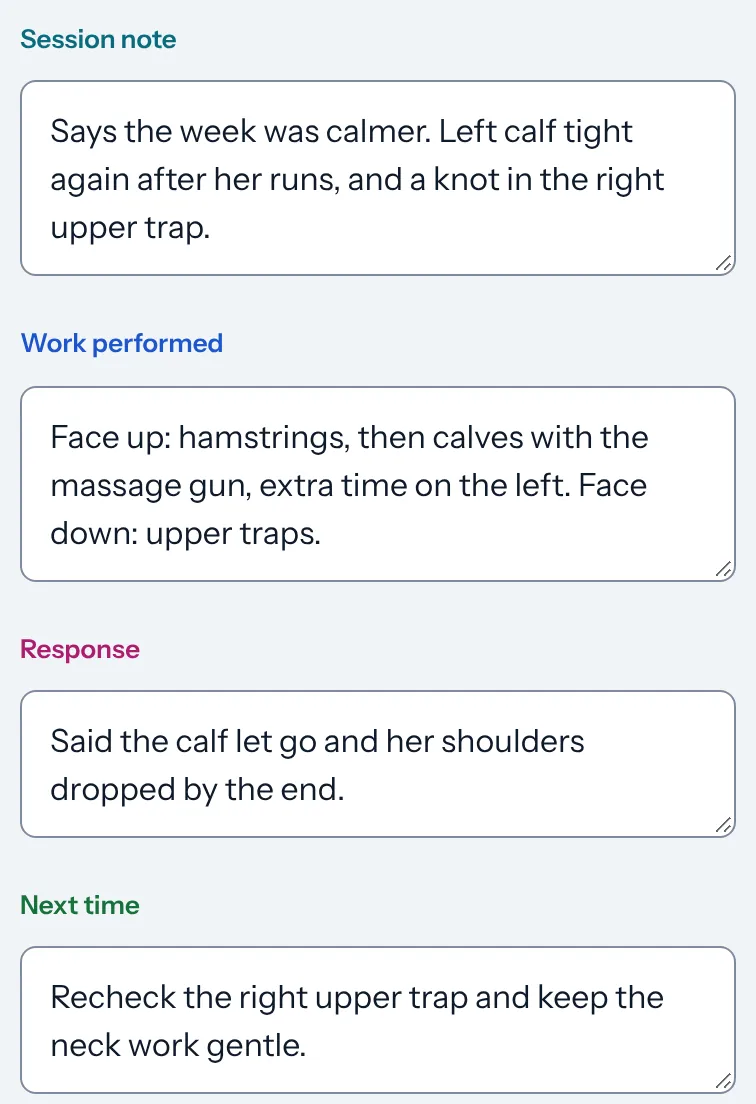
I built Dorsova because I wanted this note done before the next client walked in. You talk for a minute or type four short boxes, check it, and paste it into your booking software. Before the session, a 30-second brief puts their injuries and what to avoid first, then last time’s note. The client’s goal sits under Why they’re here, and an issue like that calf stays on their profile until you tap Resolve, and after that it’s still on record.
Sources
- Replication and Analysis of Ebbinghaus’ Forgetting Curve, Murre and Dros, PLOS ONE (2015)
- The Psychology and Neuroscience of Forgetting, Wixted, Annual Review of Psychology (2004)
- EHR Time-Stamp Accuracy in the Operating Room, HealthManagement.org (summary of a Journal of Medical Systems study)
- Safe Record Keeping in Nursing Practice, Royal College of Nursing
- SOAP Notes, StatPearls, NCBI Bookshelf