In this guide
With one studio, you can read over a shoulder. At three, you can’t. Notes drift: one location writes paragraphs, another writes “good session,” and the third writes nothing on Fridays. The client who moves between them gets three different experiences, and the practitioner who covers a shift at the other studio walks in knowing nothing.
Here is how I’d go about it, in order.
Fix the shape, not the style
Don’t ask for good writing. Ask for the same four answers every time: how they came in, what was done, how they responded, what’s next. Those four turn “good session” into something the next person can use. Style can stay personal. Shape can’t. A note in a minute has the four lines.
The easiest way to get the same shape everywhere is to hand every studio the same blank. The session notes template is one paragraph, the client’s precautions first, and it pastes into any booking software. Pin it up beside the front desk at every location, and use it in training. If your studios use shorthand, agree on one list for the whole company, like the key in the stretch client note template, and don’t let each location invent its own.
Say what “thin” means
A thin note isn’t a bad note. It’s one that can’t help anyone: no side, no area, no next step. Agree on two or three tests and keep them short enough to remember:
- Does it say which side? “Hamstrings tight” fails. “Left hamstring tight” passes.
- Does Next time say what to do? “Continue” fails. “Start with the left hamstring, ask about the drive” passes.
- Would the next practitioner know what to avoid? If the client has an avoid list, the note shouldn’t contradict it without saying why.
Then show what you mean. The same session, written twice:
Good session. Worked legs and back.
Came in: Says low back tight after a long drive, 4/10. Work: Face up: hamstrings, hips. Face down: low back, light. Response: Said the back felt looser. Left hamstring still tight at the end. Next: Start with the left hamstring. Ask how the drive home was.
Put the pair in front of every team once. Nobody needs it explained twice.
Look at the gap, not each note
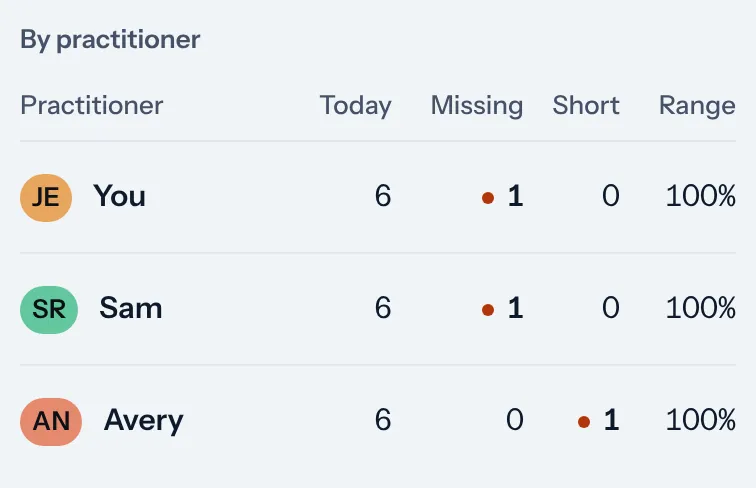
Reading every note is a full-time job. Look at the gaps: which sessions have no note, which notes are thin, and by whom and where. A weekly look at those two lists, by practitioner and location, finds the Friday problem within a week instead of a quarter. In Dorsova, the owner’s Dashboard shows exactly that, and Notes to finish lists each missing or thin note by name.
When one location’s numbers look different, ask before you assume. A studio with more first visits writes longer notes. A studio that’s short-staffed on Fridays needs a fixed moment for the note, not a lecture; writing notes between back-to-back clients is that routine.
Keep one record per client
If a client trains at two locations, both should see the same injury history and the same avoid list. When each location keeps its own, the second studio asks the injury questions again, or worse, doesn’t. A single client record the whole company shares is the point. Some companies prefer to keep clients per studio, and that works too, so decide it on purpose. What happens to that record when a practitioner leaves is in client history when staff leave.
Ground rules
- Every practitioner reads the brief before the session. Make it the habit, not the exception.
- The note is written within minutes, not at night.
- Caution levels are the practitioner’s call. Nobody else’s note overrides them.
Start new people the same way everywhere
Consistency breaks first with new hires, because each studio trains them a little differently. Use the same first week at every location: the same sample clients, the same reading order for the brief, the same template. Training new practitioners to read a client brief is that week, day by day, and handing a new practitioner their first clients covers which clients they see first.
Check on a schedule
Once a week, ten minutes. Pick three notes at random from each location, read them as if you were the next practitioner, and ask whether you’d know what to do. If yes, move on. If not, share the one thing that would have fixed it, with the person, kindly. Praise the good ones out loud, by name; that does more for the next month’s notes than any correction.
If the booking system already holds the notes, see how Dorsova and ClubReady notes can sit side by side, with one paste between them.
Common questions
How do I get practitioners at different studios to write notes the same way?
Give every studio the same four-part template, agree on two or three tests for a thin note, and show one thin and one good note side by side. Then look at which notes are missing or thin each week, by practitioner and location, rather than reading every note.
Should each location keep its own client records?
Usually not. A client who visits two studios should have one injury history and one avoid list that both can see. Some companies choose to keep clients per studio; that works if it’s decided on purpose.
How often should an owner check note quality?
Once a week for about ten minutes: look at the missing and thin notes by practitioner and location, then read three notes at random from each studio as if you were the next practitioner.