In this guide
On a full day, the gap between clients isn’t really a gap. You’re changing the sheets, wiping down, refilling water, reading the next brief, maybe eating half a granola bar. The note is the first thing that gets pushed to later. Later turns into 7 pm, and by then it’s six clients’ worth of guesswork.
The fix isn’t more time. It’s one fixed moment that never moves.
Pick one moment, and keep it
Decide exactly when the note happens, and make it the same every time. For most people that’s the moment the door closes behind the client. Before you change the sheets, before you check your phone, before you open the next brief.
Why then? Because memory drops fastest in the first hours [1], and five more clients is a lot of interference. The note you write at 10:52 about the 10 am client is right. The one you write at 7 pm is a blend of the 10 am and the 2 pm.
UK nursing guidance says the same thing in one line: make records at the time, or as soon as possible after [2]. We’re not nurses, but it’s a good rule to borrow.
Some practitioners say “I’ll do it once the room’s reset.” That works if you’re strict about it. The trouble is that resetting the room has a way of turning into checking the schedule, which turns into a client walking in early.
The order that fits the gap
Five minutes, roughly:
- Door closes: the note (about a minute).
- Reset the room (two or three minutes).
- Read the next brief (30 seconds), then glance at it again when they walk in.
If the note slips, it’s always the reset that should give, not the note and not the brief. A slightly messy room is fine. A missing note isn’t.
What to skip when you’re slammed
A fast note is short because it leaves out what won’t help next time. On a packed day, cut harder.
- The routine. If you ran your usual sequence, say “usual sequence” and only note what was different.
- The chat. One personal line, written as a question for next time. Not the whole conversation.
- Guesses. “Probably slept funny” helps nobody.
- Anything you’d have to look up. Write what you did, not the name of the technique you can’t remember.
What you never skip, however rushed:
- The side. Left or right is the first thing to vanish from memory.
- Anything that touched a caution. If you stayed off the left knee, say so.
- What the client reported, in their words.
- Next time. That’s the line the next session starts from.
A rushed note that still works
Between two clients, this is plenty:
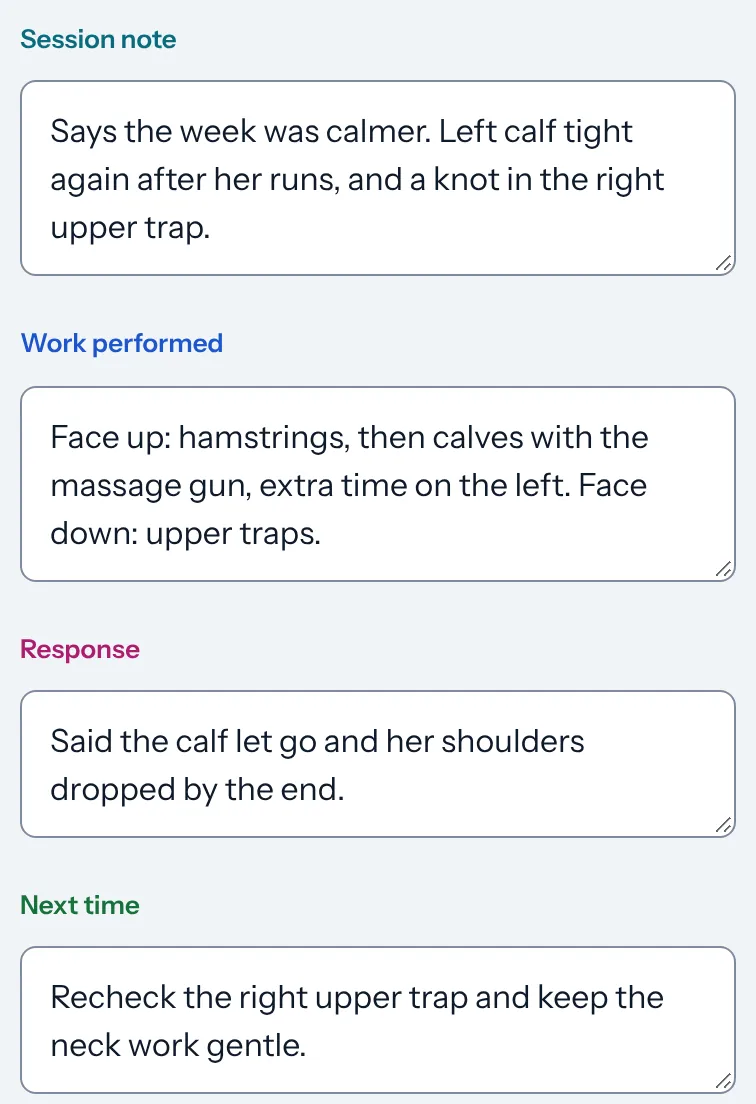
Came in: Says low back “tight” after driving, 4/10. Work: Usual sequence, skipped the lying twist, lighter on left glute. Response: Said back felt looser. Next: Start with the left hamstring. Ask about the drive home.
That’s four short lines, and the next person can work from it. How to write session notes fast has the four lines in full and a thin note next to a good one.
When talking beats typing
Typing works when you’ve got a free hand and a minute. Talking it out loud is often quicker when:
- Your hands are busy. You’re wiping down the table or folding a towel.
- The session had a lot of order. “Face up, hamstrings then hips, one turn, face down, calves” is faster said than typed.
- You’re walking. From the room to the front desk.
Typing is better when:
- The next client is already in the room, or someone’s within earshot. Their details shouldn’t be heard by the next client.
- It’s loud, and the dictation will mishear half of it.
- It’s one line. “No changes, same as last week” is quicker to type.
Whichever you use, check who hears the audio before you trust any dictation. Some tools send it to a speech service, some keep it on the device. Voice-to-text for session notes covers how to speak so it comes out right.
Where Dorsova fits
A new stretch note in Dorsova opens ready to talk: say it for about 30 seconds, and it sorts what you said into the note’s boxes for you to check. Or type four short boxes. The button says who hears the audio. Then Save note copies it, ready to paste into your booking software, and you’re on to the next brief.