In this guide
The practitioners who seem to remember everything about everyone usually don’t. They’ve got a routine. A minute before each client, they read, and then they say one thing out loud that shows they did. Clients think it’s memory. It’s a habit, and anyone can have it.
Stop relying on your head
Memory works fine for five clients. It falls apart at forty, and it falls apart completely when somebody else saw your client last Tuesday. Trying harder doesn’t help. Writing it down and reading it back does.
AFPA’s article on remembering client health information makes the same point for trainers and coaches: keep a file on every client, and review it right before the session starts, so the details are fresh [1]. They put it down to the recency effect, the way we remember best what we’ve just seen [1]. Beverly Hosford, writing for NFPT, describes the low-tech version: a small memo pad with each client’s routine and a binder of notes per client, kept somewhere safe, which also lets a substitute trainer pick up where she left off [2].
The tool matters less than the habit. What matters is that the notes exist and you read them every time.
The 60-second routine
Before they walk in (30 seconds). Read three things, in this order:
- Cautions. Injuries, surgeries, what to avoid. This is the one you can’t get wrong.
- Last time’s Next time. What you or someone else said to do today.
- One personal thread. The recital, the trip, the new puppy.
Before a stretch session goes through the full check in order. This is the short version for the gap between clients.
While they warm up or settle in (20 seconds). They’re taking off their shoes, filling a water bottle, getting on the bike for five minutes. Glance again. Most of us read something and lose half of it in the walk from the desk to the room. A second look while they settle is when it sticks.
In the first minute (10 seconds). Say one thing from the note out loud.
- “How did the 10K go?”
- “Last time the left hip was the tight one. Still the same?”
- “Did you make it to Florida?”
That’s it. One line, and the client knows they’re known.
What to read, and what to skip
You don’t need their whole history every session. You need what changes today.
- Read: the cautions, the last note’s Next time, where they were tight, one personal thing.
- Skip: the full intake, old notes from months ago, the routine you always run.
If something in the cautions is new or you don’t recognize it, stop and read that part properly. That’s the one exception.
Write it so you can read it in 30 seconds
The routine only works if the note is quick to read. Long paragraphs don’t get read between clients. Short lines do.
A thin note:
Good session. Client happy. Talked about her trip.
Which trip? What happens next? Nothing in there helps you next week.
A good one:
Came in: Says right shoulder a bit stiff after a long flight. Work: Face up, hips then hamstrings, lighter on the right shoulder. Response: Said the shoulder felt easier by the end. Next: Recheck the right shoulder. Ask how the Lisbon trip was.
The personal thread goes in Next time, written as a question to ask. That’s how it gets remembered. Trainers, the same applies beside the training log: personal trainer session notes has where the “why” goes.
The things clients notice
A few details make a bigger difference than any technique:
- Their name, and the names they mention. “How’s Maya’s recital?” lands better than “How’s your daughter?”
- The side. “Your left knee” beats “your knee.” It shows you read it.
- The goal. “Still aiming for the spring 10K?” connects today’s work to why they come.
- That you followed through. If the last note said to recheck the hamstring, recheck the hamstring, and say so.
None of it needs a good memory. It needs a good note and a minute to read it.
Those details are a big part of why clients come back. The rest, from the goal to booking the next session before they leave, is in how to get clients to rebook.
Where Dorsova fits
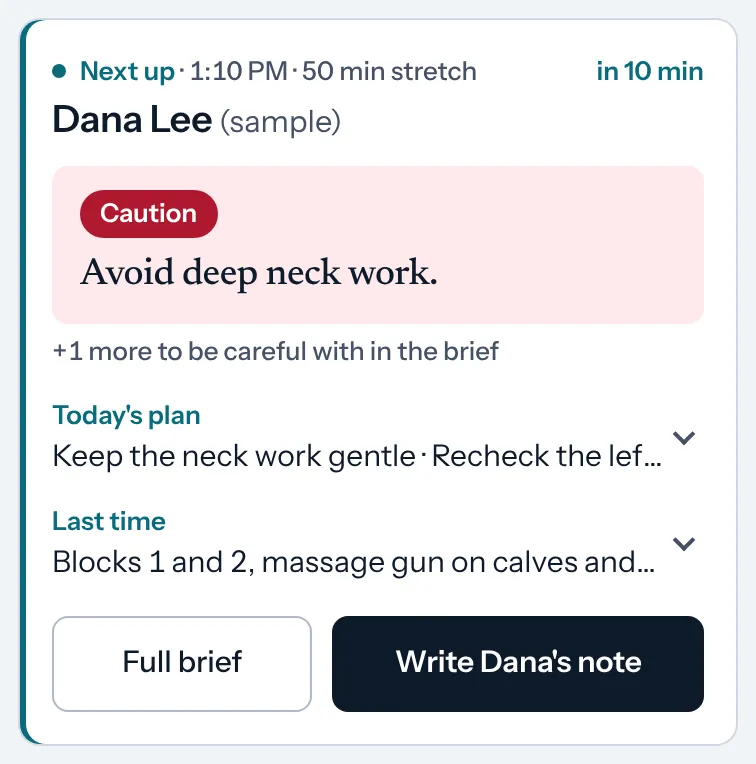
Dorsova puts this routine on one card. Next up on Today shows the client’s caution, today’s plan from last time and what to ask about, and Full brief opens the rest. Read it in the gap, glance again while they settle, and ask the one question.