In this guide
People don’t rebook because of a technique. They rebook because they felt like you knew them, and that’s the part most studios leave to chance.
You’ve probably seen it go both ways. A client comes in, the practitioner asks how the calf is doing after last week, picks up right where they left off, and mentions the golf trip the client brought up. That client books again before they’re off the table. Another client sees someone new who opens with “so, what brings you in?” for the third time. Nothing was wrong with the session. They just don’t come back.
What the research says about why people stay
There’s a good body of research on why people stick with a service provider, and it lines up with what you see on the floor.
Gwinner, Gremler and Bitner asked customers in long-running service relationships what they got beyond the service itself. They found three kinds of benefit [1]:
- Confidence. Trust, less worry, knowing what to expect.
- Social. Being recognized, being known by name, a bit of friendship.
- Special treatment. Extra attention, better service, sometimes a better price.
In their study, confidence came first in importance, then social, then special treatment [1]. A later study by Hennig-Thurau, Gwinner and Gremler looked at how those benefits, together with satisfaction and commitment, lead to loyalty and word of mouth [2].
For us, confidence means the client trusts you know their history. They don’t have to explain the shoulder surgery again, and they don’t have to worry the new person will crank on their neck. That trust is built from records as much as from hands.
Rapport matters too. Gremler and Gwinner studied the relationship between customers and the employees serving them and found two sides to rapport, enjoyable interaction and a personal connection. Both were linked to satisfaction, loyalty intentions and word of mouth [3].
In physical therapy, the equivalent idea is the therapeutic alliance, the working relationship between patient and therapist. A 2017 scoping review found 26 articles that looked at whether alliance was connected to adherence, and 57% of them showed some correlation [4]. That’s not proof that a good relationship makes people show up. It is a reason to take the relationship seriously.
Start with the macro goal
Every client has a macro goal, the thing that brought them in. “I want to play eighteen holes without my back seizing up.” “I want to get down on the floor with my grandkids.” Then there’s the micro issue, whatever’s in front of you today, like the back they tweaked shoveling or the calf that’s been tight since Sunday’s run.
Deal with the micro issue, because that’s where a lot of value gets created. But connect it to the macro goal out loud. “Let’s work on the back today, and then we’ll get back to the hip work for your golf.” That sentence tells the client you remember why they’re here, and it gives them a reason to come back that’s bigger than today’s knot.
Follow through on last time
The note you wrote last session is a promise. If it says “next time, recheck left hamstring and ask about the 10K,” then the next session should start there.
So read it before they walk in. Recheck the thing you said you’d recheck. Ask the thing you said you’d ask. If you did block one, then hamstrings, then calves last time, and the calves were still tight, start there this time and tell them why.
And write the next-time line properly so whoever sees them next can follow it too. A client who books with a different practitioner and still gets “how did the 10K go?” feels remembered by the studio, and not only by one person. That matters most the week a practitioner leaves.
Following through only works if you remember what they told you. How to remember every client’s details is the 60-second routine I use before each session.
Book the next one before they leave
This is the simplest thing on the list and the one people skip. Before the client’s out the door, ask when they want to come back, and get a date and a time on the calendar.
There’s research behind why a specific plan helps. In a field experiment at a large company, Milkman and colleagues mailed employees reminders about free flu shot clinics. Some reminders also asked people to write down the date and time they planned to go. That group’s vaccination rate was 4.2 percentage points higher than the 33.1% in the group that only got the reminder. Asking for a date alone made a smaller difference that wasn’t statistically significant [5]. A flu shot isn’t a stretch session, so I don’t push that further than it goes. But the lesson I take from it is that “come back soon” is weaker than “Tuesday at 4.”
How I do it:
- Tie it to the plan. “Next time I want to get into the hips more. Does next Tuesday work?”
- Make the gap make sense. If they’re working toward something, say how often makes sense for that, and let them decide.
- Don’t pressure. If they want to check their calendar, fine. Follow up the next day.
Some clients drift anyway. Bringing back clients who’ve gone quiet covers who to message after three to six months and what to say first, and late cancels and no-shows covers the friendly wording for the sessions that don’t happen.
The little things
None of this is complicated. Remember their name and what they told you. Ask about the recital, the golf trip, the new job. Know their injuries without them having to repeat them. Pick up where you left off.
The hard part is doing it every time, for every client, no matter who they book with. Memory doesn’t scale past one practitioner with a light book. Notes do.
Where Dorsova fits
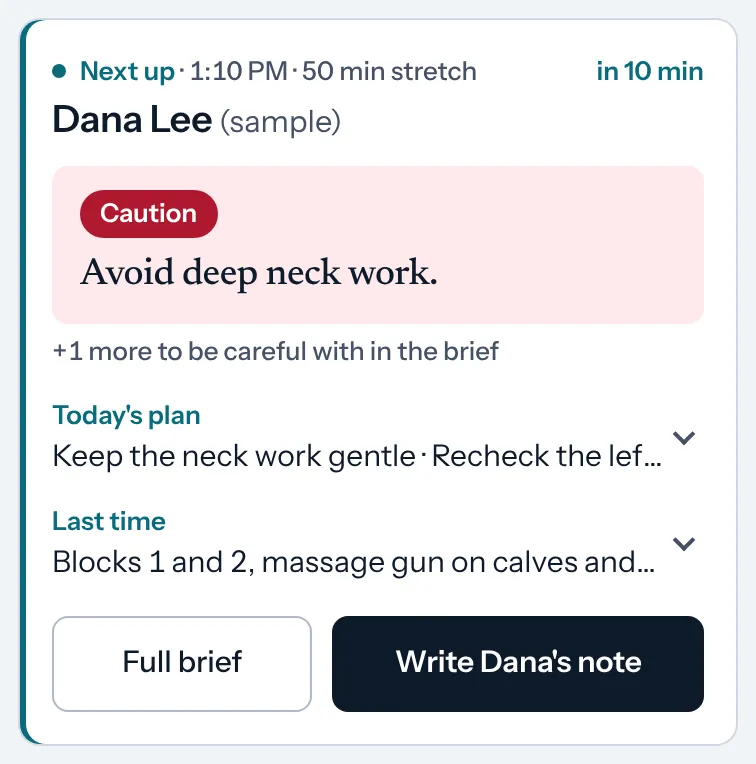
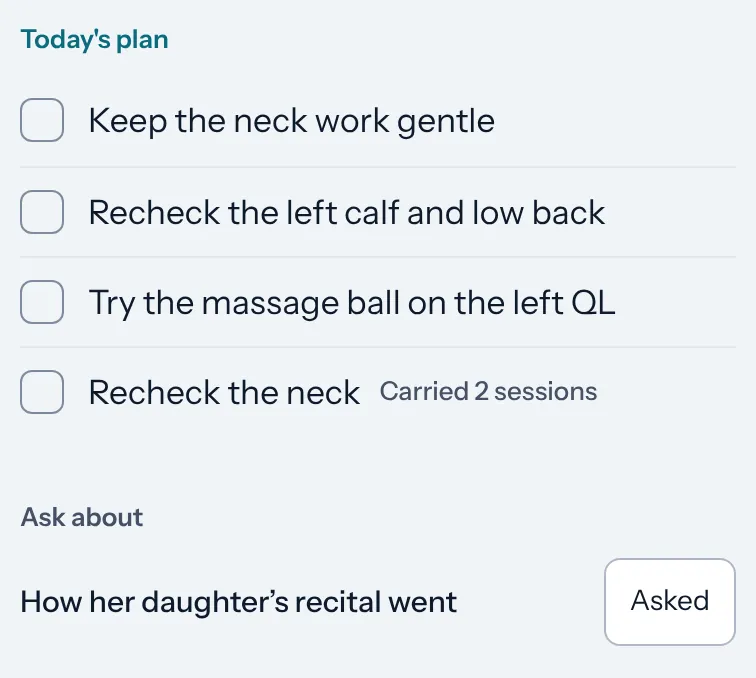
Dorsova gives you a 30-second brief before every session with their injuries and what to avoid, where they were tight last time and what to ask about, whoever they book with. Plan for today brings back what to recheck and what to ask about from the last note, and you tap Asked when you have. Every note says who wrote it and what to do next time.
Sources
- Relational Benefits in Services Industries: The Customer’s Perspective, Gwinner, Gremler and Bitner, Journal of the Academy of Marketing Science (1998)
- Understanding Relationship Marketing Outcomes: An Integration of Relational Benefits and Relationship Quality, Hennig-Thurau, Gwinner and Gremler, Journal of Service Research (2002)
- Customer-Employee Rapport in Service Relationships, Gremler and Gwinner, Journal of Service Research (2000)
- Characteristics of therapeutic alliance in musculoskeletal physiotherapy and occupational therapy practice: a scoping review of the literature, Babatunde, MacDermid and MacIntyre, BMC Health Services Research (2017)
- Using Implementation Intentions Prompts to Enhance Influenza Vaccination Rates, Milkman, Beshears, Choi, Laibson and Madrian, PNAS (2011)