In this guide
Here’s the note I’d hand a new stretch practitioner on their first day. Copy it into whatever you write notes in: your booking software’s notes box, a notes app, a shared doc. Fill in the brackets after every session. It’s one paragraph of plain keyboard characters on purpose, because a lot of booking software mangles anything fancier.
The template
Stretch note | PRECAUTION: (anything on their avoid list, or leave this part out) | NEXT: (one or two things for next time, and what to ask) | CAME IN: (what they told you, in their words) | WORK: Face up: (areas, in the order you did them). Face down: (areas, in order) | INTENSITY: (how far you went, and how they wanted it) | FOUND: (side, area, what you found) | RESPONSE: (what they said, what changed)
Copy it as it is. The order matters more than the labels, so rename anything your studio already calls something else.
What goes on each line
- PRECAUTION. The client’s avoid lines, written as movements: “No deep flexion at the right hip.” Leave it out when there’s nothing. It goes first because it’s the line the next person has to read. (How to word these is in how to write a client avoid list.)
- NEXT. One or two specific things. “Start with the left hamstring. Ask how the flight home was.” It’s second because it’s the plan, and the next person needs it before they read about last time.
- CAME IN. What they told you at the start, in their words. Pain or tightness only as theirs: “Says low back tight after the drive, 4/10.”
- WORK. Every block, in order, with the position. Face up first, then the turn, then face down, or the other way round. If the line reads face up, face down, face up, they turned over more than they needed to.
- INTENSITY. How far you took it and how they wanted it, on whatever scale your studio uses. “Kept the hamstrings light, client wanted a 5.” The next person won’t take someone who likes it gentle straight to a 9.
- FOUND. Side, area, what you found, the same words every time. “Left hamstring tight. Right upper trap, knot.” If it’s “tight” this week, don’t make it “restricted” next week, or it looks like something changed when only your wording did.
- RESPONSE. What they said, during and after, and what changed in the session. “Said the right hip let go. Left hamstring still tight at the end.”
The same template, filled in
A made-up regular, a good week:
Stretch note | PRECAUTION: Avoid deep neck work | NEXT: Start with the left calf. Ask how the 10K went | CAME IN: Says left calf tight after Sunday run, 3/10. Neck fine this week | WORK: Face up: hamstrings, hips, then calves with extra time on the left. Face down: upper traps, light | INTENSITY: Medium, client wanted a 6 on the hamstrings, lighter on the traps | FOUND: Left calf tight. Right upper trap, knot | RESPONSE: Said the calf let go by the end. Knot at the right upper trap eased with pressure
That took under a minute, and someone who’s never met her could run her next session from it. Three more filled-in notes, a first visit and a client with a fresh tweak among them, are in assisted stretch session notes.
A shorthand key
Shorthand is fine if the whole studio reads it the same way. Agree on one list, pin it up, and don’t invent new ones mid-week. Here’s a short one that covers most stretch notes:
| Write | Means |
|---|---|
| L, R, B | Left, right, both |
| FU, FD, SL, ST | Face up, face down, side-lying, seated |
| HS | Hamstrings |
| Glutes, HF | Glutes, hip flexors |
| QL | The muscle between the lowest rib and the top of the hip, low back |
| ITB | The band down the outside of the thigh |
| UT | Upper traps |
| /10 | The client’s own number for pain or tightness |
| ROM | Range of motion, an estimate by eye, for tracking progress. Not a clinical measurement. |
“L HS tight, R UT knot” reads fine to anyone with the key. “Pt c/o LBP” doesn’t belong in a stretch note at all: it’s clinic shorthand, and it makes the note read like a chart you aren’t writing.
Leave these out
The template keeps you to what you can stand behind, and these are the lines that slip in anyway:
- Diagnoses you didn’t receive. “Sciatica”, “piriformis syndrome”. Only as the client reported them: “Says her doctor called it sciatica.”
- Treatment words. “Treated”, “corrected”, “fixed her hip”. Write what you did and what they said.
- Guesses about cause. “Tight from sitting too much” is a guess. “Says she sat for six hours on the flight” is a record.
The full list, and why, is in SOAP notes for non-clinicians.
If it’s going into booking software
Paste it as one paragraph. Line breaks, bullet points, curly quotes and emoji are where old notes boxes fall over, and a note that opens with one word and a colon (“Client: …”) can get read as a web address on an iPad. That’s why the template opens with “Stretch note |”. The rest of the paste rules are in ClubReady session notes, and they hold for most booking software.
Where Dorsova fits
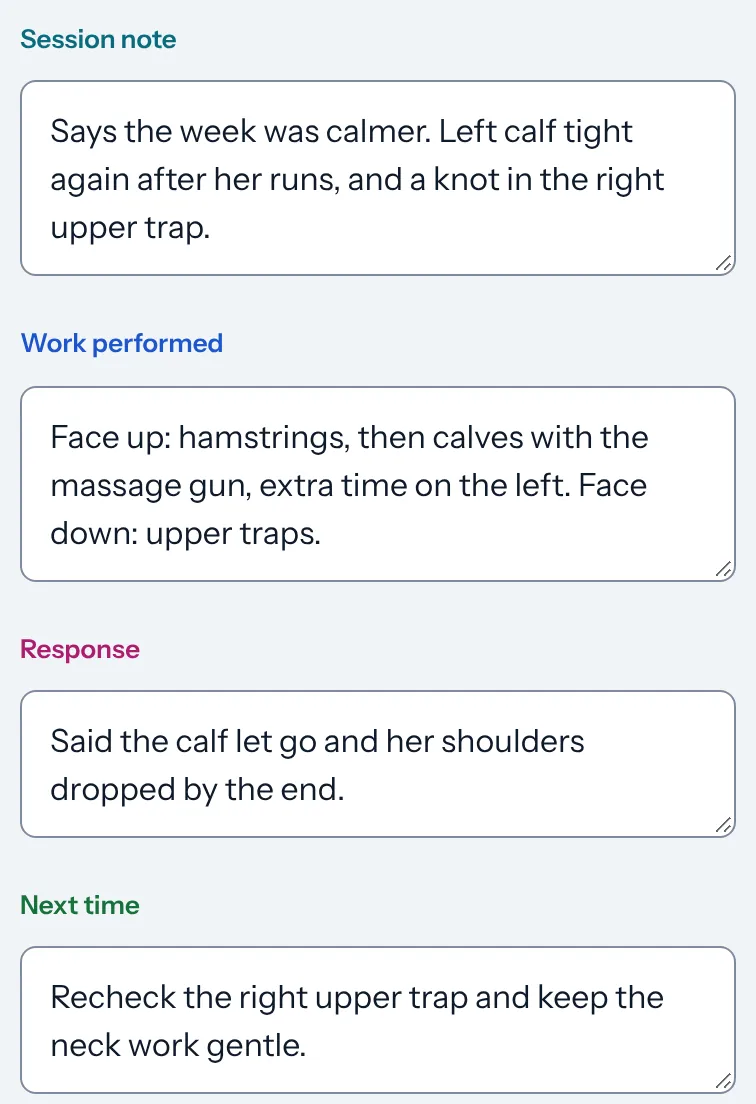
I built Dorsova so nobody has to fill this in by hand. After the session you talk for a minute or type four short boxes, and Dorsova sorts it into the note, marks the body map when you say the side, the area and what you found, and copies it as one plain paragraph, precaution and next first, ready to paste. Before the next session, that note comes back as a 30-second brief for whoever they book with.